 PRISM
PRISM Emma Scanlan
 367
367by May Chen
This case study presents a small-scale example of how I used generative AI (GenAI) as a pedagogic thinking partner in the design and delivery of a Foundation Year healthcare seminar. It is offered as a relective account of how GenAI supported the reinement of existing teaching materials into a more active, focused, and professionally relevant learning experience.
Context, risk, goal, and shift
This seminar, focusing on immunity across the lifespan and vaccination, ran from 12–2 pm, following a 9–10 am lecture on related anatomy and physiology content. While the lecture and seminar addressed the same broad theme, the seminar needed to operate in a different learning mode. My main concern was that the seminar could still feel like a passive extension of the earlier lecture: more information, more sitting, and more listening, at a point in the day when students’ attention and energy might already be stretched. At the same time, the teaching environment was somewhat constrained. PowerPoint projection was available, but there were no other teaching aids, including flipcharts or white boards, to support interactive learning.
This raised the question of how I could move beyond content coverage and create a seminar that was more active, focused, and manageable, while helping students consolidate and extend learning from the lecture without losing coherence. GenAI became useful here as a pedagogical thinking partner, helping me refine and enact the learning more deliberately. The seminar materials already contained useful content and a sensible sequence, but I wanted support in translating that sequence into a clearer learning structure for students. In particular, I wanted to think through how to create a stronger opening to the session, how to organise active-learning tasks more clearly, how to make abstract concepts easier to understand, and how to extend the discussion into practical and professional application. For me, the value of GenAI lay in helping me refine teaching strategies and move from covering content towards designing meaningful learning.
What I did in practice
Creating a stronger entry point
To create a stronger opening, I began the seminar with a question rather than further explanation: Why can the same virus cause very different experiences in different people — mild illness for one person, but severe illness for another? This prompt was deliberately chosen to reconnect students to their earlier learning on immunity while also inviting curiosity and participation. Rather than beginning with more content transmission, it framed the seminar around a problem to think through. Students responded immediately, with one student identifying “immunity” as the key factor, which helped open up the session and indicated that prior knowledge was being activated. This was a small change, but an important one. It shifted the tone of the seminar from receiving information towards inquiry. It also helped create continuity between the lecture and the seminar without making the seminar feel like a repetition of the lecture.
Turning broad content into a focused active-learning task
One section of the seminar explored how immunity changes across the lifespan. Without careful structuring, this topic could easily have become a diffuse list of age-related features, with students encountering many disconnected points but struggling to retain the overall pattern.
Through discussion with GenAI, I reshaped this into a more focused and manageable group task. Each group focused on one life stage and identified one immune strength and one immune vulnerability. This gave students a clear and well-bounded task, rather than asking them to absorb a wide range of loosely connected details. What worked well about this approach was its cognitive clarity. It organised the learning more coherently, supported peer discussion, and made thinking visible through the reporting-back process. In that sense, the task did not simplify the content in a reductive way; rather, it structured the content in a way that made meaningful engagement and retention more likely.
Making abstract concepts visible and easier to discuss
When the seminar moved to vaccination, I wanted students to understand why coverage levels matter at population level. Percentages alone can remain abstract, particularly for students who are still developing confidence in interpreting public-health concepts. Originally, I considered whether classroom props might help represent different coverage scenarios, but this was not practical in the room and would not have captured the wider population-level picture clearly enough. I therefore used GenAI to help generate simple visual representations of different vaccination coverage scenarios (Figure 1).
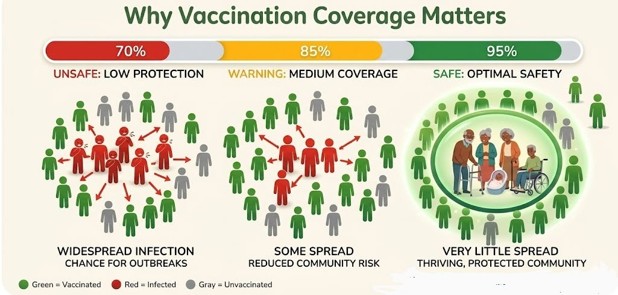
Figure 1
These visuals allowed students to move beyond percentages and consider what different levels of uptake might mean in practice. They helped make herd immunity more visible and more discussable, and supported a richer conversation about the consequences of lower uptake. This then opened space for discussion of the tension between individual choice and collective responsibility, particularly in healthcare contexts where the decisions of individuals may affect the viewpoint of others who are vulnerable. Importantly, the discussion did not stop at abstract ethics. The visual prompt also helped extend the seminar into practical communication, including how future health professionals might respond to vaccine hesitancy in a respectful, informed, and professionally appropriate way. In this sense, the use of GenAI supported not only disciplinary understanding, but also ethical reasoning and the development of practical communication skills relevant to students’ emerging roles in healthcare.
How this supported student learning
This example was designed to support student learning in several ways that align with the aims of the case study call.
First, it supported disciplinary knowledge by helping students engage with key concepts in immunity, vaccination, and public health. Rather than simply revisiting lecture material, the seminar sought to make these concepts more learnable through questioning, task structure, and visualisation.
Second, it encouraged critical thinking. Students were invited to reason through why people may respond differently to the same virus, how immunity changes across the lifespan, and what different levels of vaccination coverage may mean at population level. These were not questions of simple recall. They required comparison, interpretation, and consideration of consequence.
Third, it opened space for ethical understanding. The vaccination discussion moved into the tension between personal autonomy and wider social responsibility, particularly in healthcare contexts where professional responsibilities extend beyond respecting individual choice to consideration of patient safety and public health.
Fourth, it supported professional readiness and employability by extending discussion into communication and role-relevant decision-making. Students were not only asked to understand the content, but also to consider how they might respond to vaccine hesitancy in a respectful, informed, and professionally appropriate way as future health professionals. I did not collect formal student feedback for this session, so I would not want to overstate impact. However, student engagement was visibly evident at points in the seminar. In particular, students responded readily to the opening prompt, which appeared to activate prior knowledge and invite participation from the outset. More broadly, the session felt more coherent and interactive because it was shaped around questions, bounded tasks, and visible prompts rather than around slide progression alone.
What I learned about using GenAI
One important lesson for me was that GenAI did not take over my professional judgement and pedagogical thinking. Its usefulness depended on my being clear about the learning challenge, the constraints of the learning environment, and the kind of learning experience I was trying to create for students.
In that sense, GenAI was only useful because it was guided by a pedagogic direction. I had to identify the educational problem, judge what kind of activity was appropriate, recognise which ideas were feasible, and decide what was worth keeping or discarding. The technology could generate many possibilities, but it could not replace the teacher’s judgment about learners’ needs, context, or educational purpose.
For me, this was the most valuable insight: GenAI did not replace teaching expertise; it supported reflective teaching practice. It helped me clarify the learning goal, sharpen activity design, visualise abstract ideas, and extend content into more applied and professionally relevant learning. It helped me think more clearly about how students would encounter the learning.
Reflective takeaways
This example suggests that one useful way of using GenAI may be when staff already have teaching materials, but want support in making learning more focused, active, and engaging.
In particular, it may help colleagues to:
- convert broad topics into more bounded and manageable tasks,
- visualise concepts that are difficult to convey through text alone, particularly where suitable videos or other visual resources are not readily available
- and turn discussion into real-world and professional relevance.
In summary, GenAI, when used judiciously, can support the move from outlining content to designing richer learning experiences. In my experience, its value was greatest when pedagogy remained firmly in the lead and GenAI was used not as a substitute for educational judgment, but as a tool to help refine and enact it more deliberately.


