 Expert comment
 Jeanette Earl
 2112
2112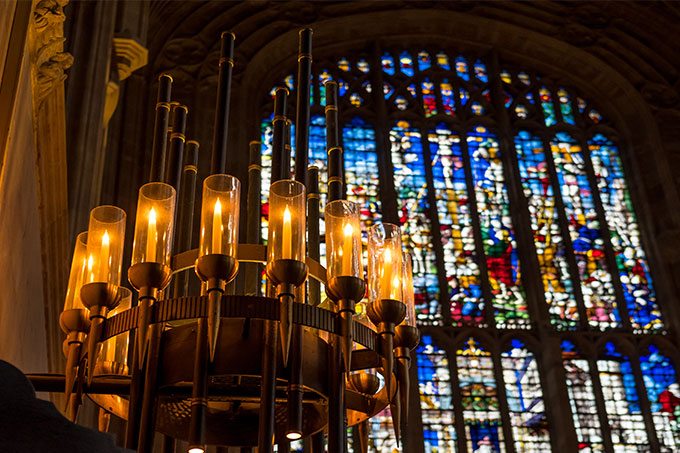
Professor Janet Melville-Wiseman urges you to look beyond the obvious, and find hope this season in the unfamiliar and unexpected.
For many people the annual Festival of Nine Lessons and Carols from the chapel of Kings College Cambridge represents the authentic start to Christmas. It is held each year on Christmas Eve which also marks the end of the reflective period of Advent in the Christian Calendar. This is out of step with commercial Christmas which starts earlier and earlier each year along with the pressure to buy more stuff. Overlaying both, are the daily news reports of war, targeted violence, and deep despair.
The recent government budget statement was heavily scrutinised for how far it would go to end poverty related despair including for thousands of children in the UK. But it was also scrutinised in terms of who was going to carry the financial burden of reducing that poverty and whether that would be fair or effective. The longing to find hope for all can seem elusive.
The annual Festival of Nine Lessons and Carols began in 1918 and now follows a well-rehearsed format where the Christian message is told through the story of the birth of Jesus and beyond. The opening carol is always Once in Royal David’s City when a boy treble steps forward to sing the first verse as an unaccompanied and quiet solo. It prepares us to temporarily quiet our inner despairs and draw near to listen to a story – a once upon a time story – a story of both hope and despair and the complex interface between the two.
Each year, the service also includes a specially commissioned new carol, and for 2025 it has been composed by Rachel Portman best known for her film and drama scores including “Emma”, for which she received an Oscar, “Chocolat”, and “Cider House Rules”. For this commission though she has taken the Thomas Hardy poem “The Darkling Thrush” and set it to music for choir.
The poem portrays Hardy’s despair for how civilisation was evolving leading up to the turn of the century in 1900. He uses his observations of the harsh, rural, winter landscape of that time as a metaphor for his concerns for the world:
I leant upon a coppice gate
When Frost was spectre-grey,
And Winter’s dregs made desolate
The weakening eye of day
He also describes people retreating indoors to escape the unbearable cold thus leaving the winter landscape empty of human presence and connection.
But then he describes hope arriving in an unexpected form of birdsong:
At once a voice arose among
The bleak twigs overhead
In a full-hearted evensong
Of joy illimited;
An aged thrush, frail, gaunt, and small,
In blast-beruffled plume,
Had chosen thus to fling his soul
Upon the growing gloom
It was not the species of bird we usually associate with joyful singing or bringing hope in poetry or real life. We usually expect the birdsong of larks, or nightingales, or more festive looking robins to bring us winter cheer – but this was an aged thrush.
So, this winter, if you experience personal despair, or the despair of how our contemporary world is shaping up, look beyond the new, the perfectly formed, or the in tune, and instead look out for the metaphorically beruffled – it could be unfamiliar so may take a while to recognise, but when found could be bringing the best of hope.
The world premiere of The Darkling Thrush can be heard on BBC Radio Four at 3pm on Christmas Eve, broadcast live from Kings College Cambridge Chapel Festival of Nine Lessons and Carols.
Janet Melville-Wiseman is Professor Emerita in Social Work in the School of Social Work, Education, and Teacher Education.


