 Expert comment
 Jeanette Earl
 39
39
Professor Kristy Howells explains why this week’s red heath-health alert emphasises the need to start talking about heat literacy.
Last week I wrote about amber heat alerts and the importance of moving from heat awareness to heat readiness.
A week later, that conversation has changed.
We are now facing red heat-health alerts.
That distinction matters because red heat-health alerts are not simply hotter versions of amber heat -health Alerts. They represent a point where the potential impacts extend beyond traditionally vulnerable groups and into the wider population. In simple terms, amber alerts ask us to prepare. Red alerts ask us to act. For parents, teachers, coaches and community leaders, the question is no longer whether it is hot. The question is whether the conditions remain appropriate for the activities we had planned.
Heatwaves are no longer rare events. They are becoming part of the environments in which children learn, play, move and grow. The challenge is no longer responding to exceptional weather. The challenge is adapting childhood to a changing climate.
Children are not simply smaller adults. Their bodies regulate heat differently, producing more metabolic heat during movement, dissipating heat less efficiently, and acclimatising more slowly than adults. These physiological differences increase children’s vulnerability during physical activity and periods of extreme heat.
Perhaps most importantly, children are often completely absorbed in what they are doing. Whether playing, cycling, climbing or taking part in sport, they frequently continue long after adults would have recognised discomfort and stopped. Children do not always tell us they are overheating. Often, their behaviour tells us first.
This is why understanding heat stress and heat strain matters.
Heat stress is an environmental challenge. Heat strain is the body’s response.
High temperatures, humidity, direct sunlight, hot surfaces and physical activity all contribute to heat stress. Heat strain may appear as fatigue, irritability, headaches, dizziness, nausea, reduced concentration, emotional dysregulation or unusual tiredness. Importantly, heat strain is not experienced equally.
Children do not experience heat in the same way. Children living with obesity may experience greater physiological strain because excess adipose tissue can reduce heat dissipation and increase cardiovascular demands. Children with diabetes face additional challenges linked to dehydration, hyperglycaemia, impaired thermoregulation and cardiovascular strain. Some commonly prescribed medications, including antihistamines, stimulant ADHD medications and certain antidepressants, may also affect sweating, thirst perception or fluid balance. For these children, additional planning, monitoring and support may be required during periods of extreme heat.
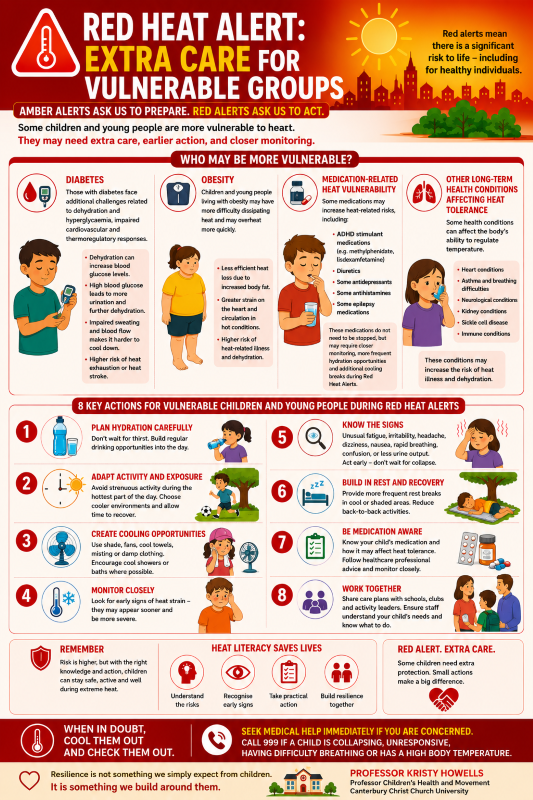
That is why red heat-health alerts require more than awareness. They require action.
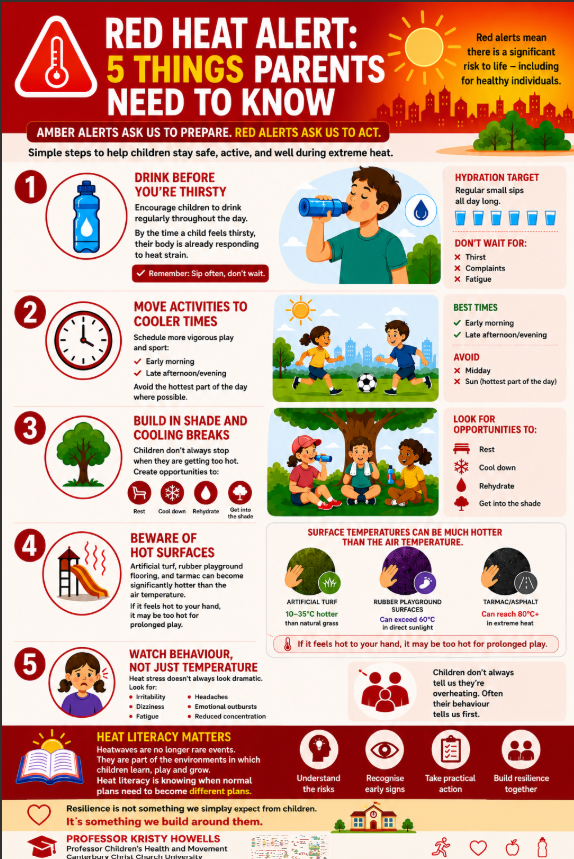
The practical advice remains relatively simple: encourage children to drink before they feel thirsty, move vigorous activities to cooler parts of the day, build regular shade and cooling breaks into routines, be mindful that artificial surfaces can become substantially hotter than the surrounding air temperature, and pay close attention to changes in behaviour, mood and energy levels.
But we must also think beyond this week.
Red heat-health alerts are a reminder that the environments in which children learn and play are changing. Historically, schools, playgrounds and sporting environments have been designed around temperate-climate assumptions. Increasingly, those assumptions are being challenged.
Heat literacy matters
Heat literacy is not about creating fear. It is about giving children, families and communities the knowledge and confidence to adapt safely.
Just as we teach road safety and water safety, we need to help children, families and communities understand how heat affects the body, recognise the early signs of heat strain, and know when normal routines need to change.
Looking ahead, we also need to move beyond simply reacting to heat. The future is not just heat awareness. It is heat readiness. It is anticipating risk earlier, building more resilient environments, and using better information to support safer decisions for children.
The goal is not to stop children playing, learning or being active. The goal is to ensure they can continue to do so safely in a warming world.
Because resilience is not something we simply expect from children. It is something we build around them.
Professor Kristy Howells is a Professor in Children’s Health and Movement in the School of Sciences, Psychology, Arts and Humanities, Computer Engineering and Sports.


