 Expert comment
 Jeanette Earl
 826
826
As the Children’s Wellbeing and Schools Bill reaches its final stages in the House of Lords, Professor Kristy Howells asks if the Bill will achieve its aim to ‘introduce a series of safety measures, with a focus on a joined-up system, to stop vulnerable children falling through cracks in services’.
Sleep, movement, nutrition and belonging are not extras, they are the infrastructure of children’s wellbeing.
We have become fluent in the language of children’s wellbeing, yet far less attentive to the conditions that sustain it. A happy child is not a slogan or a policy promise. It is a child who slept well, moved regularly, ate adequately, felt valued and knew they belonged. When these foundations weaken, wellbeing does not collapse overnight, it erodes quietly, through everyday distress.
The World Health Organization defines wellbeing as a positive state of life quality and meaning. In childhood, it is visible in emotional regulation, resilience, engagement and belonging. Yet children’s life satisfaction is declining, and dissatisfaction with school continues to rise.
As reform efforts progress through the Children’s Wellbeing and Schools Bill, we must confront a structural truth: wellbeing cannot be legislated into existence if a child’s daily life is organised around depletion.
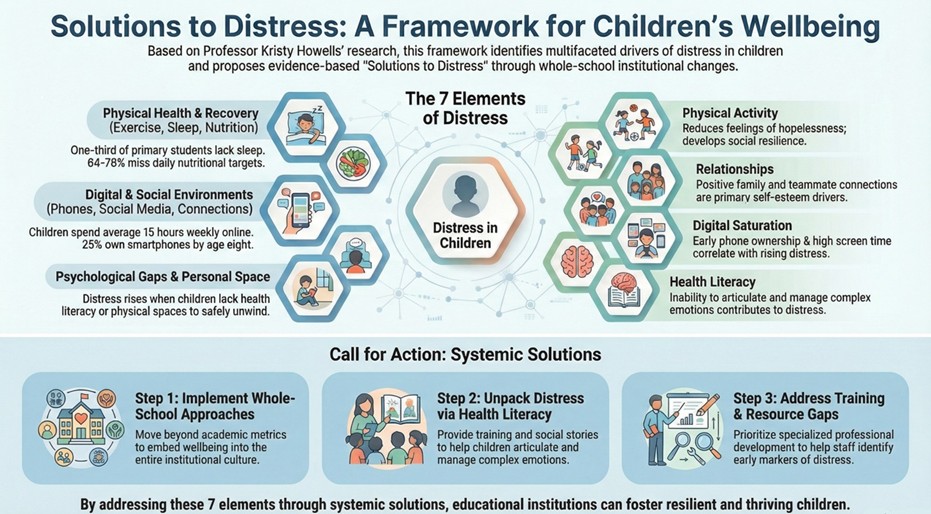
Over more than a decade of my research into children’s physical activity, health and education, seven recurring distressors consistently emerge as barriers to thriving. Together, these form a practical framework for identifying and addressing the upstream conditions that quietly undermine children’s wellbeing. In schools across the country, these conditions are not theoretical; they are daily realities playing out in classrooms, playgrounds and homes.
1. Lack of movement.
Movement is not enrichment; it is regulation. Regular physical activity supports emotional stability, stress reduction and psychological resilience. Without it, children’s regulatory capacity weakens.
2. Not feeling valued.
When children feel unseen or unheard, their sense of worth erodes. Belonging is not a soft extra, it is protective infrastructure.
3. Inability to switch off.
Children require genuine opportunities for restoration: unstructured play, creative activity, quiet space. Constant stimulation leaves little room for recovery.
4. Broken connections.
Supportive relationships buffer adversity. When relational security weakens, vulnerability increases.
5. Digital overload.
An always-on environment alters sleep, attention and self-perception. Screen saturation reshapes developmental conditions in ways we are only beginning to fully understand.
6. Poor nutrition.
Food underpins cognition, emotional regulation and physical health. Inadequate or inconsistent nutrition compounds other stressors.
7. Sleep deprivation.
Sleep is the master regulator. Without it, emotional control, learning and behaviour deteriorate rapidly.
On their own, these factors may seem manageable. Taken together, they create something far more destabilising – a distressed foundation.
We cannot expect sustained improvements in attendance, behaviour or attainment while children are exhausted, sedentary, undernourished, socially disconnected or digitally overwhelmed. Nor can mental health strategies succeed if everyday physiological and relational needs remain unmet.
The task before schools, families and policymakers is not to multiply wellbeing initiatives, but to use this framework to systematically remove the daily distressors undermining children’s capacity to thrive. Whole-school approaches and system reform must therefore move upstream, embedding sleep, movement, nourishment, connection and protected recovery time as core educational priorities rather than peripheral concerns.
Wellbeing is not constructed through rhetoric. It grows or withers through everyday conditions.
You cannot build a healthy mind on a distressed foundation.
Recognising and dismantling these seven distressors is not an optional enhancement to education policy. It is the groundwork upon which children’s resilience, learning and long-term health depend.
Kristy Howells is Professor of Children’s Health and Movement, in the School of Sciences, Psychology, Arts and Humanities, Computer Engineering, and Sports. For more information on her research, or if you’re interested in undertaking research in this area, do get in touch with Professor Kristy Howells via email: kristy.howells@canterbury.ac.uk.


