 Library
 Isabella Scollard
 104
104
In the first Read and Relax blog, we welcomed in the new collection at Augustine House, a selection of fiction and non-fiction for leisure reading.
But what are the benefits of reading beyond your university curriculum titles?
In this blog, we will venture into the power of reading and what we hope you gain by picking up some new titles and expanding your mind.
So why is reading important and what does it offer us?
Similar to our library StressLess events, the Read & Relax collection aims to provide an escape from the pressures of studying, and reading is widely suggested to significantly reduce stress by slowing the heart rate, easing muscle tension, and reaching a relaxed state of consciousness.
Reading is a chance to tackle our growing screen time, not only giving your eyes a break from the blaring blue light, but also resting your mind. The stress and whirring hum of everyday life slow and create a mental haven as you exist in a capsule of heightened focus that configures the written words into visuals, sounds, smells, and whole new worlds. This gift of stillness in escapism is the power of reading.
In a world that operates rapidly, with racing stimuli and technology, it is common to feel an intense digital fatigue. Stepping away from the screens to instead open a book regularly provides active engagement and centralised concentration that is believed to help slow cognitive decline in later years.

Image created by EdenMoon, sourced by Pixabay, Content License – Pixabay.
Yet with our weakened concentration due to all the short-form content vying for our attention, it is normal to struggle reaching this heightened focus when reading. Think of it like meditation; it takes practice and active effort. Be kind to yourself and take it a chapter at a time, or even a page. The benefits may take time to fully realise, but the effects are everlasting.
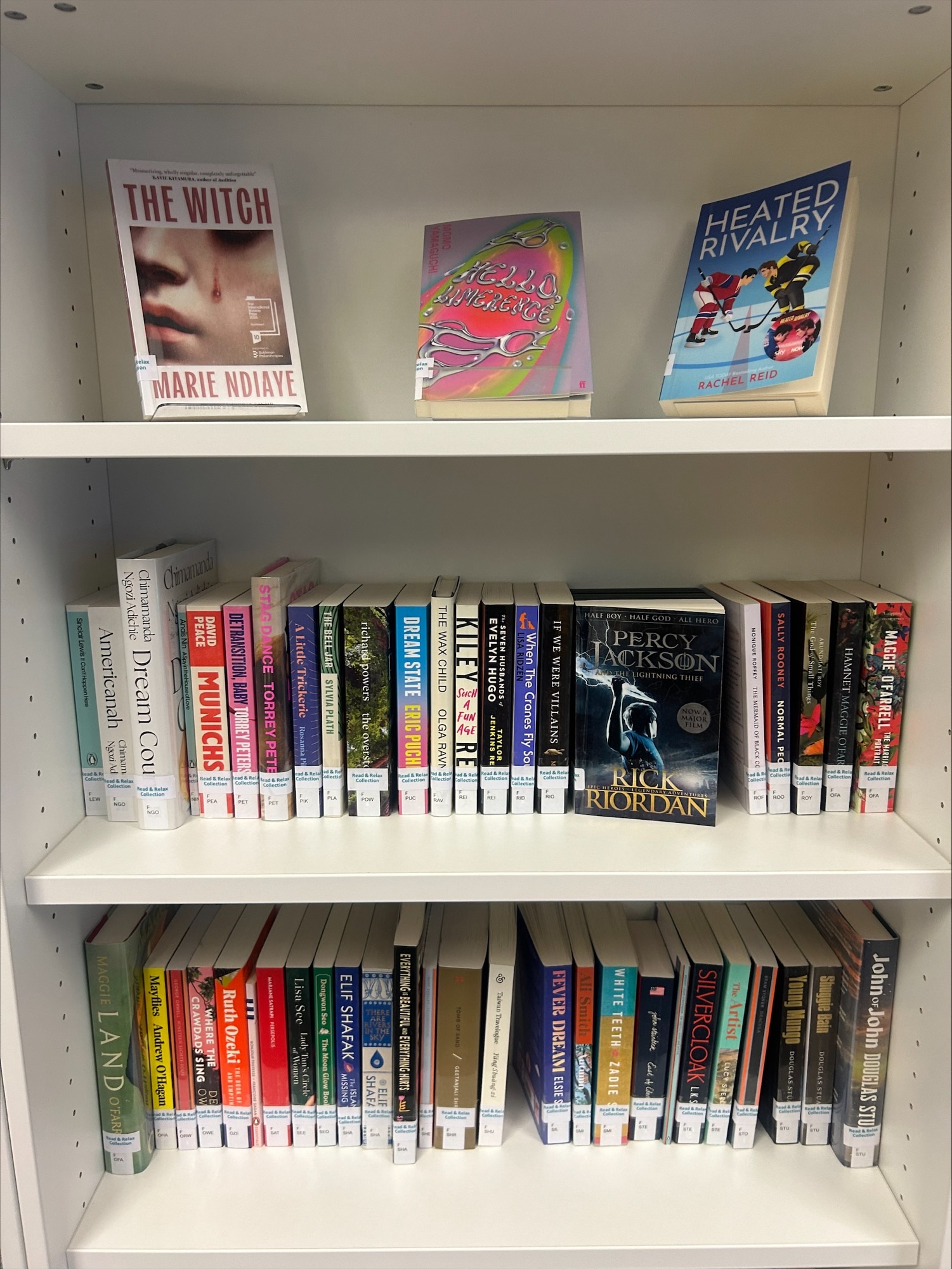
Photo of a Read and Relax bookshelf taken by library staff.
Alongside the quiet serenity books offer, there is also greater cognitive awakening. I almost picture a machine, where all the cogs slowly creak and awaken with life, pulsing electrical thoughts in intersecting patterns. Readers often experience a feeling called serendipity, where, after reading about a topic, a particular event or person, you suddenly notice connections to it everywhere.
These traces of human history and culture have always been there in the background, but reading alights your mental pathways to recognise these interweaving threads of life. Everything begins to link, and this cascade of realisation feels as if dusting away the dirt to reveal a coveted artefact. It feels surreptitious, as if all the magic of the world has revealed itself to you.
Of course, this ‘magic’ is partly the increased empathy gained from reading. Reading for pleasure offers escapism but also connection. Reading about other perspectives, cultures, and worlds increases our emotional intelligence and ability to relate to one another.
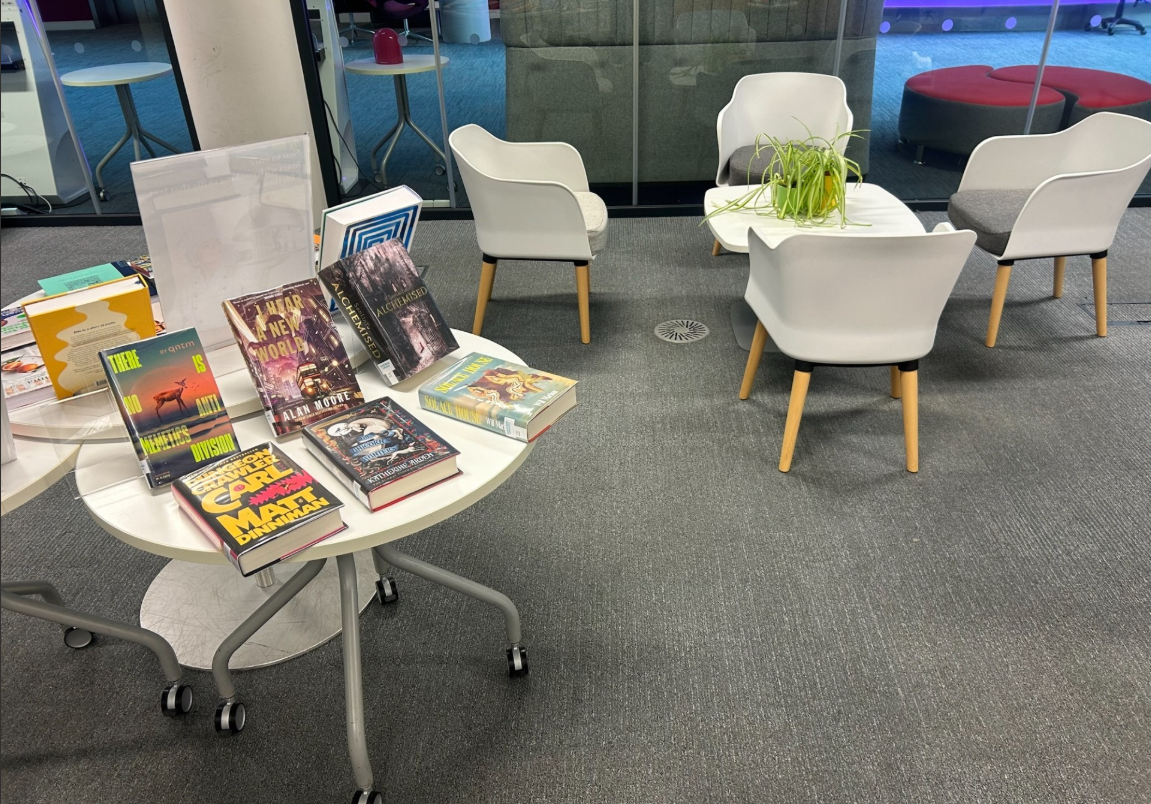
Photo of Read and Relax area, taken by library staff
As an exclusively solitary activity, yes, reading is associated with increased life satisfaction, self-esteem, and quality sleep. However, it is only in recent years that I discovered how reading is intrinsically social, how immersing yourself in a book means you are never really alone when amongst the comfort of characters.
Moreover, your thoughts are given weight and language to express outwardly to others, your conversational skills flow, and feelings can become internally processed as your experiences are tangibly captured on page and translated across stories. Your vocabulary naturally expands, and the scope of topics to talk about becomes infinite. You may strike up a conversation with a stranger as you hold the same book, or send a friend a story that reminds you of their nature, or even join a book club to release your bubbling opinions about a certain plot-line.
You have but one life, books let you borrow a thousand more.
Alongside socialisation and education, university for many is an essential stepping stone to advance their professional career, and reading can only support these career goals further. Those who read regularly are thought to have great problem-solving and analytical skills, better memory, as well as a knack for creativity and critical thinking – all of which are highly sought after by employers!

Image sourced by Adobe Stock, created by Kiattisak under the Education License.
Government research suggests that those proficient in reading during primary school earn, on average, £65,000 more during their lifetime (Department for Education 2025).
Vitally, reading for pleasure can also make your mind feel more your own. Away from the dopamine hits of digital media, your choices become more authentically yours, less influenced by the predestined algorithms. Life no longer trudges along on autopilot; your dopamine levels regulate, and the world opens up to you.
I read somewhere that reading means ‘even ordinary moments become easier to interpret because books feel like leaving little lamps around your inner life ‘, and I feel this perfectly sums up the sentiment.

Image sourced from Adobe Stock, created by MUHAMMAD under the Education License.
Nowadays in the current culture, it seems books have never been cooler…
There appears to be a growing appetite for intellectual stimulation with the rise of celebrity book clubs (think Service 95 by Dua Lipa), reading retreats popping up all over Instagram, bookish communities booming on apps like TikTok, and recent fashion trends, such as Coach’s release of miniature readable book charms! In this age of AI and media, our concentration is corroding, our drive diminished. Filling up on long-form content like books is powerful and reminds us what it is to be human and how to switch on and think.
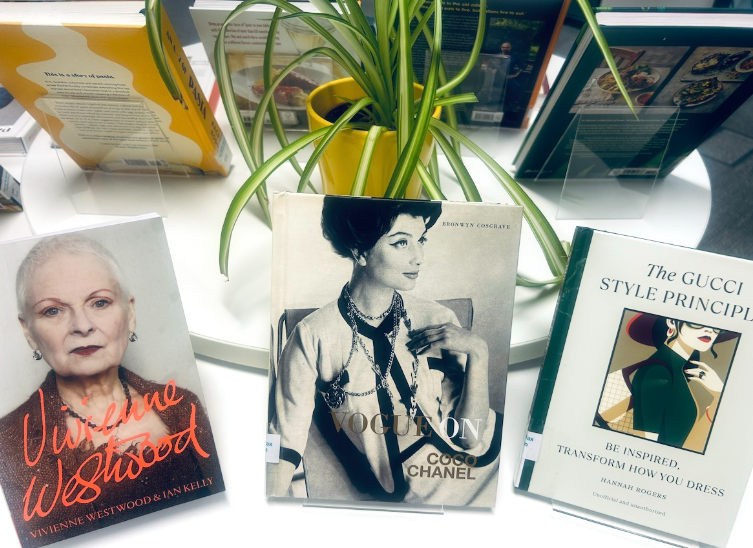
Image taken by library staff of the Read & Relax collection
There is often discourse surrounding how Gen Z may use reading as an aesthetic to appear curated, clever, and cultured versus the statistics of how much people are actually reading. However, doesn’t performance in some turn become reality if there’s reading ultimately happening in the process? You don’t need to read 50-plus books a year, but dipping your mind within the pages every now and then already gives you a whole new wealth of access to the world.
While the active readers online may be a small but loud minority, research does suggest that children and young people’s enjoyment of reading has risen for the first time since 2021 (Sales 2026) and, despite fears of illiteracy, reading has continued to persist and adapt throughout time. The shift away from solely the physical book has widened access considerably.

Image sourced from Adobe Stock, created by Shine.Graphics under the Education License.
In a culture that worships the hustle, time is a commodity; it’s a luxury. Holding a book in your hands today comes with its own cultural capital, as the time and mental effort associated with reading, previously cast as inefficient compared to advancements in technology, is now the very thing that has increased its appeal. Luckily, the Read & Relax collection consists of more than solely physical books, offering a range of reads on the Libby app too. Short on time? Try an E-book while you commute. Too tired to read and too many tasks to complete? Listen to an audiobook in the background.
Reading is for everyone; it should not be a luxury, but a right, and this is why libraries are so important!
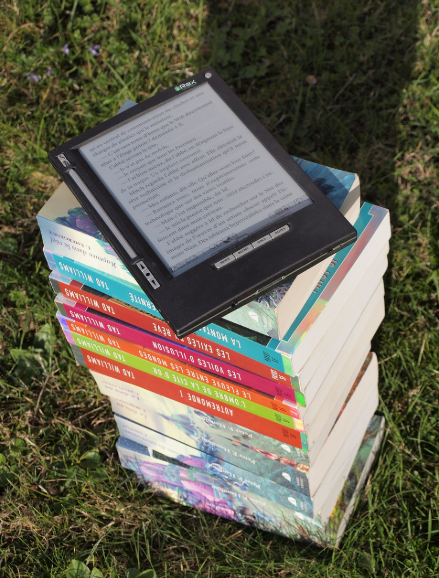
Image created by janeb13, sourced by Pixabay, Content License – Pixabay.
Moreover, E-books and audiobooks cater for those with disabilities, those who are perpetually busy, and countries beyond the Western climate where publishing has been traditionally centralised. People may trivialise the use of mobile devices to read versus a physical book, but for example, even the United Nations has highlighted technology’s role in expanding access and increasing reading rates within countries where physical text is scarce (UN News 2014).
So, have a look at some of our curated collections on Libby and help us grow our collection by suggesting books you would like added to the shelves. Fill out the form via our QR code or the attached link below to enter a competition. You will be in for the chance to win a Teddy Bear and a £30 bookshop voucher.
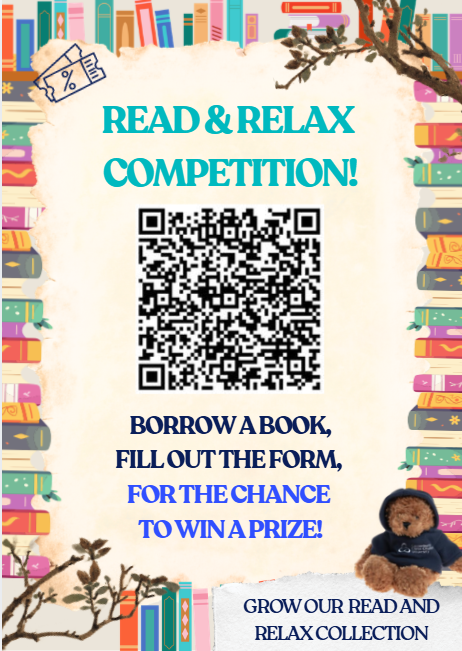
Read and Relax is a community space:
The term ‘Third space’ is the concept that we spend most of our lives either in ‘first places’ (our homes) or ‘ second places’ (work), but there is an additional unique third category – think cafes, pubs, libraries. It’s a social environment where we can rest, create, and relate to the world around us. In other words, they are spaces that are the beating heart of community.
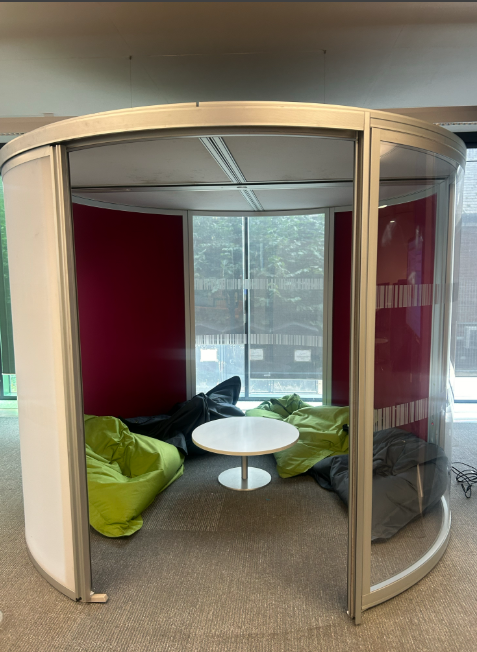
Photo taken by library staff of the book nook.
As touched on earlier, reading is a great way to feel connected to others, and this Read & Relax space is designed as a third space for you to enjoy your student community – sift through stories, play chess, and converse with those around you. Even sitting in silence but being present amongst the hum of people nearby is thought to help combat loneliness and isolation.
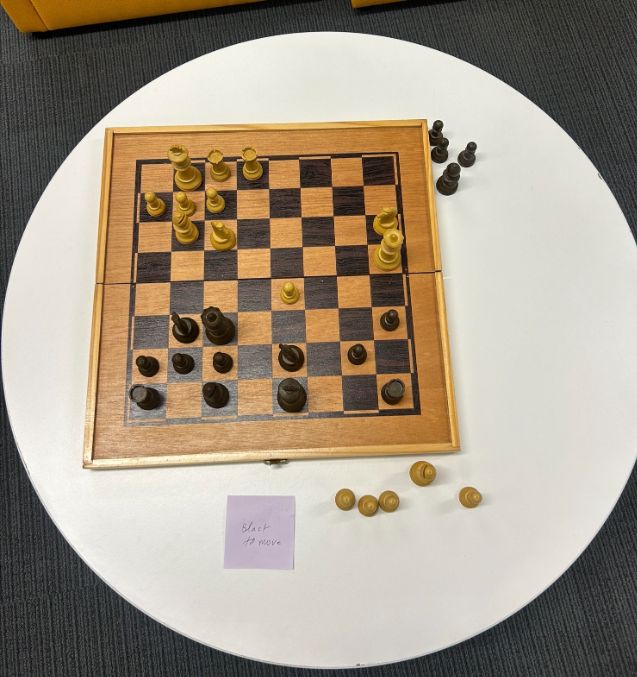
Photo taken of chessboard being used by students and communicating via post-it notes
Nowadays, it is rare to find community spaces that are free and inclusive, but that’s the beauty of libraries.
Your university library is about more than sticking solely to a strict reading list; it’s also about expanding your mind… Slip into fictional worlds, engage with different cultures and perspectives, then share your findings and enthusiasm with others.
In closing…
Reading for leisure will genuinely enrich your life; you gain pleasure from an entertaining story, empathy from inhabiting another perspective, fulfilment from an artfully crafted sentence, recognition from the voicing of familiar feelings, wisdom from psychological insight, and the freedom to imagine other worlds.
However, as reading itself is a creative act, two readers can have vastly different connections to and experiences of a book, so maybe the benefits mentioned above don’t particularly resonate with you, but it’s in your hands now to seize some inspiration, grab a book off the shelf and explore what emotions or mental pathways are stirred.
You don’t have to enjoy every book or genre, but even this clarity from disliking something is a door to open, a trail to follow, and a discovery of character.
References
- Department for Education (2025). Parents urged to read more to boost children’s life chances. [online] GOV.UK. Available at: https://www.gov.uk/government/news/parents-urged-to-read-more-to-boost-childrens-life-chances [Accessed 22 Aug. 2026].
- Sales, D. (2026). Uptick in children and teenagers enjoying reading for first time in 5 years. BBC News. [online] 10 June. Available at: https://www.bbc.co.uk/news/articles/cze93wggw74o [Accessed 22 Aug. 2026].
- UN News (2014). World book day: New UN report spotlights potential of mobile technology to advance literacy. [online] UN News. Available at: https://news.un.org/en/story/2014/04/466662 [Accessed 20 Aug. 2026].
Main image sourced from Adobe Stock, created by Carballo under the Education License.


