 The Poetic Nursing Heart
 Tom Delahunt
 1268
1268
There are moments in life where chaos briefly rearranges itself into coherence.
Not perfect coherence.
Not certainty.
But enough alignment that you can finally pause, inhale deeply, and recognise that the fragments of your life may have been speaking to one another all along.
Recently, I experienced one of those moments.
Sitting in conversation with the lead researcher Dr Kenny at the Nursing and Midwifery Council, I found myself doing something I never imagined possible within formal professional space:
I read poetry.
Not as performance.
Not as entertainment.
Not as rebellion.
But as knowledge.
To sit there and read my poem Just aloud within a conversation about nursing, emotional experience, creativity, and practice was profoundly emotional for me. In many ways it felt like a completion point for my chaos mind. A strange and beautiful convergence between the academic, the artist, the nurse, and the wandering observer I have always quietly been beneath the surface.
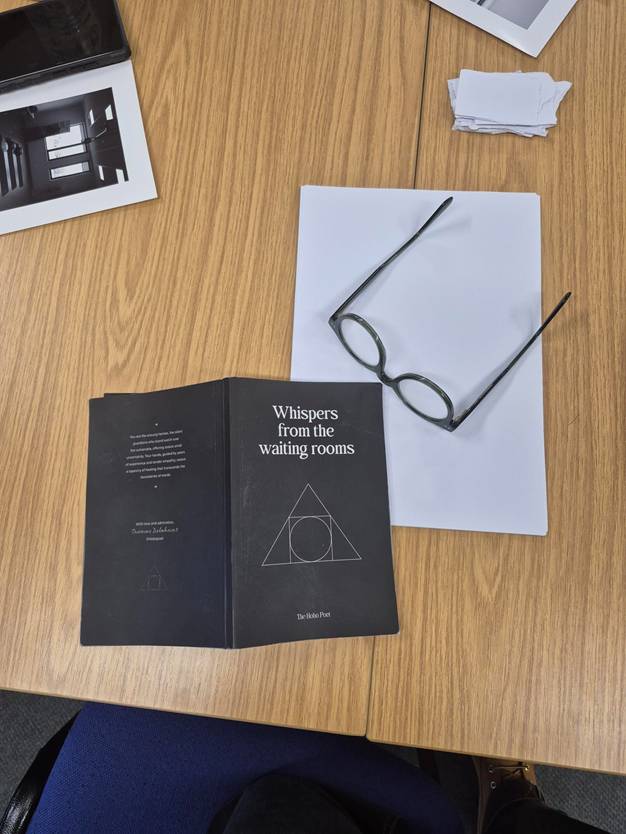
What made that moment even more significant is that Just does not exist in isolation. It forms part of Whispers in the Waiting Rooms, an unfolding body of poetic and dramaturgical work exploring emotional labour, memory, trauma, compassion, silence, and the hidden human experiences carried within healthcare systems.
The poems emerging through Whispers in the Waiting Rooms are not simply creative outputs attached to the research. Increasingly, they are becoming part of the research methodology itself.
This, I suspect, represents the next phase of my work.
Not simply writing about emotional sustenance within nursing and nurse education, but actively exploring how dramaturgical analysis, poetic inquiry, embodied storytelling, performance, metaphor, and creative reflection can become legitimate pedagogical and reflective spaces within nurse education across the UK and, hopefully, beyond.
Because something powerful happens when stories move beyond academic prose alone.
People feel them.
They recognise themselves inside them.
And sometimes, within that recognition, difficult conversations become possible in ways traditional educational approaches struggle to reach.
I believed I had to separate these identities in order to survive professionally.
The academic had to remain rigorous.
The creative had to stay hidden.
The emotional knowing had to be translated carefully into acceptable language before entering institutional spaces.
And yet, the deeper my PhD has progressed, the more impossible that separation has become.
Because my research was never truly about creativity as an “extra” within nursing.
It was about survival.
It was about emotional sustenance.
It was about understanding how non-traditional creative practices such as poetry, storytelling, visual art, dramaturgy, metaphor, reflective writing, and embodied creative spaces allow nurses and students to metabolise emotional complexity in ways traditional systems sometimes struggle to reach.
At the centre of this work sits a deceptively simple idea:
human beings do not survive through efficiency alone.
We survive through meaning.
And perhaps what has made this journey feel so personally transformative is that while researching emotional sustenance in others, I have slowly begun uncovering the architecture of my own mind too.
Over the past few years I have received diagnoses of dyslexia and ADHD. More recently, following thoughtful conversations with assessors and mentors, I have begun considering whether autism may also form part of that picture.
Not as limitation.
Not as reduction.
But as understanding.
Part of that courage emerged through encountering the work of ‘Temple Grandin’ and her reflections on neurodivergent cognition, visual thinking, and the idea that different does not mean less.
Her work gave language to experiences I had spent much of my life trying to suppress or rationalise quietly inside myself.
Because I have spent much of my life experiencing the world through patterns, atmospheres, emotional shifts, metaphors, and sensory connections that often feel difficult to explain through purely linear language.
Sometimes when patterns emerge in conversation or within spaces, I close my eyes to fully visualise them. It is as though my mind requires darkness in order to reduce the noise of the world enough for meaning to fully take shape.
I kept those experiences private.
We are taught not to express such things openly. Especially within professional life. We learn quickly that wonder, intuition, symbolism, emotional sensitivity, and nonlinear perception can easily be mistaken for weakness or irrationality.
So you become careful.
You learn frameworks.
You learn citations.
You translate visceral knowing into structured language.
Yet underneath all of that, the deeper current continues moving quietly.
Slowly now, the puzzle of my mind is beginning to lean towards loving itself.
And in that self-understanding, something remarkable seems to be happening:
more synaptic pathways feel as though they are opening and strengthening. Ideas are connecting more fluidly. Creativity feels less fragmented. The academic and artistic parts of myself no longer feel entirely at war with one another.
The older I become, the more I realise that many of the things I once tried to suppress are actually the very things shaping my work most meaningfully:
- metaphorical thinking
- emotional pattern recognition
- symbolic storytelling
- deep reflective intensity
- visual imagination
- sensitivity to atmosphere and emotional ecology
The Wandering Lamb.
The Butterfly Farmer.
Hunter Moon.
The Table of Consciousness.
The Poetic Nursing Heart.
Whispers in the Waiting Rooms.
These are not disconnected projects.
They are all attempts to translate invisible emotional and spiritual experiences into forms others can enter safely.
And perhaps that is why children’s literature became so important to me.
Within those spaces, wonder is still permitted.
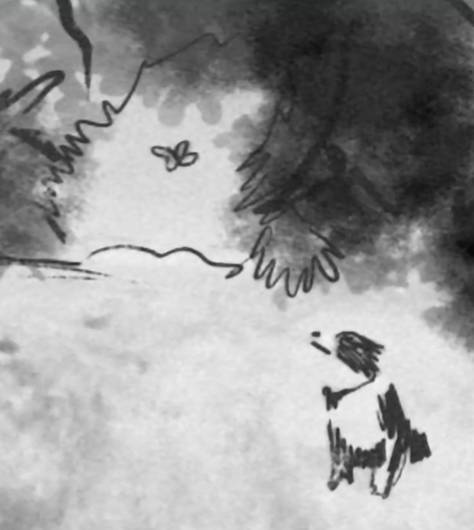
A butterfly still carries transformation.
A wandering lamb still searches for home.
The moon still watches over grief, love, loneliness, and becoming.
Nature still speaks emotionally.
Somewhere along the way adulthood often forgets how to listen to those languages.
Yet through monastic spaces, contemplative practice, poetry, creativity, and conversations with kind intellectual companions, I slowly began rediscovering them. Individuals such as Brother Bernard and other quiet mystic gatekeepers never dismissed these experiences. Instead, they listened carefully enough that I eventually learned to trust my own voice too.
That trust matters, because the next phase of my life is becoming clearer now.
Recently I came across a reflection attributed to Alfred Hitchcock:
“Happiness is a clear horizon, nothing to worry about on your plate, only things that are creative and not destructive.”
That idea has stayed with me deeply…………………………………………..
Perhaps after years of surviving systems, masking difference, compensating for neurodivergence, and trying to force nonlinear creativity into linear structures, what I truly long for now is not status or prestige.
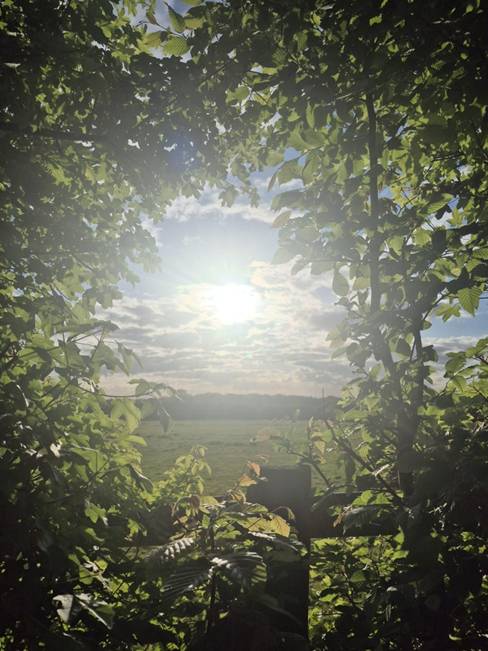
It is a clear horizon.
A horizon where creativity is not hidden.
Where neurodivergent minds are understood rather than merely accommodated.
Where emotional sensitivity is recognised as strength.
Where research and storytelling can coexist.
Where meaning is allowed space to breathe.
I can already visualise aspects of my future role within Higher Education.
I can see spaces where dramaturgical inquiry, creativity, reflective practice, neurodivergent cognition, and emotional sustenance become part of how we educate future nurses and healthcare professionals.
I can see students finding language for experiences they previously believed unspeakable.
I can see creative methodologies becoming not peripheral, but legitimate and transformative forms of inquiry.
What I cannot yet fully understand is who will create the safety required for that work to fully emerge.
Because minds like mine do not flourish through pressure alone.
They flourish through trust.
Through kindness.
Through protected creative space.
Through people willing to see difference as possibility rather than inconvenience.
I think what I am searching for now is a tempest of kindness.
An environment kind enough to allow minds like mine to fully explore meaning without fear of ridicule. A space where the academic and the Hobo Poet no longer need to exist as separate identities.
Because perhaps they never truly were separate at all.
Perhaps the PhD was not simply an academic journey.
Perhaps it was an archaeological excavation of self.
And perhaps reading Just aloud to the NMC was not simply a professional milestone.
Perhaps it was the moment my chaos mind finally realised that the very things it once feared expressing may have been its greatest contribution all along.
Latest Research
Delahunt, T (2025) The shared palette: how philosophy, art, and phenomenology can help nursing education heal trauma;
Tom Delahunt, Jonathan Barnes, (2025), The radical art of nursing, Nurse Education in Practice,
DOI: 10.1016/j.nepr.2025.10446
Delahunt, T. J. (2024). Nurturing nursing professionals: unleashing the rhizomatic power of expression, creativity, and art as resistance. PRACTICE, 1–5.


