 Centre for Kent History and Heritage
 Claire Bartram
 646
646
In this new blog series we celebrate the student experience and explore how their work in class, on placement and as volunteers shapes our understanding of Kent’s rich culture and heritage.
This week, an update from Dr Michelle Crowther Co-Lead of Kent Maps Online.
Kent means many things to many people. This year, four Applied Humanities students researched and wrote about their favourite things as part of a 40-hour work placement with Kent Maps Online. Read on to find out what they discovered.
What is Kent Maps Online?
Kent Maps Online is a digital humanities project exploring Kent’s history and heritage. Running since 2020, the project has amassed 365 articles on all sorts of local topics – from literature, history, geology, agriculture and sciences. When students apply for the placement, they are asked to pitch their ideas to the project team, who then advise on sources and images that will create an interesting article.
The fact that the placement can be done remotely appeals to students as it can be undertaken whilst studying for other modules. Additionally, there is a great deal of flexibility, with a variety of different roles from proof-reading, researching, writing, and photography to build experience which aligns with individual goals.
Applied Humanities students have contributed more than fifteen articles over the past five years. Creative writing student, Liam Cohen, was so keen to raise awareness of black history in Kent that he wrote five articles.
This year two creative writing students, one theology and one history student have created articles, playing to their disciplinary strengths. Creative writing students Helen and Teddie wrote pieces based on their personal experiences of living in Kent, whilst Tony and Eliot chose historic events that have inspired them.
Helen’s story
Helen Counsell wrote about her schooldays at Fort Pitt Technical School for Girls in Chatham. Her piece will resonate with women across Kent who have experienced the county’s girls school system in the 1970s and 80s. In an age of blazers and briefcases, Helen takes us on a journey back to the classroom, where girls sat in alphabetical order in front of roll-up blackboards. Interweaving her personal experience with the site’s past, as a fort as well as a hospital, we learn that the fifth-year form room was formerly an operating theatre and that domestic science was taught in the old ‘asylum’. Her account is full of warmth for her school days, and like many girls of the era, cookery and needlework lessons, tennis and hockey and music lessons loom large in her account of secondary education.
Teddie’s story
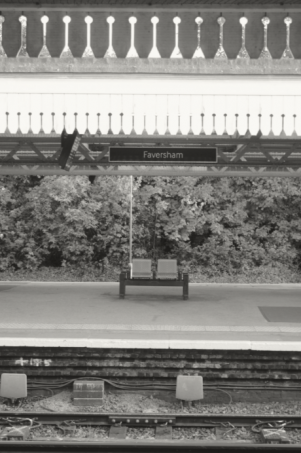
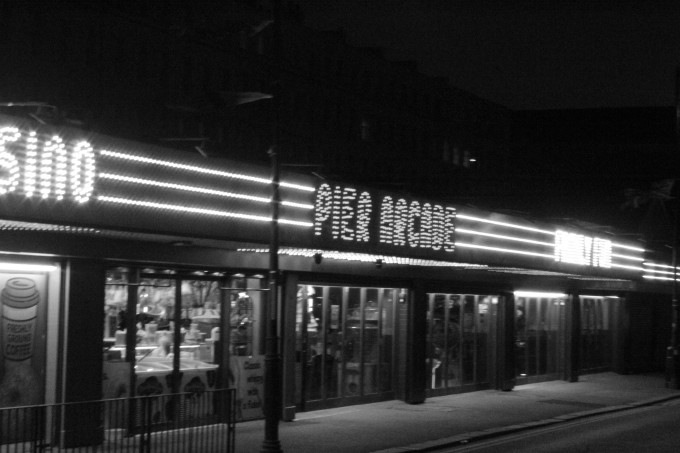
Teddie took us to Herne Bay on a day out: “A packed train, hot air and the wisp of illness in my throat. I could feel the pressure of bodies in the carriage, the workers behind me, the mother to my right and the children dangling from a bar above me”. Calling the piece, Suffocation on Sea, Teddie provides a neurodivergent perspective of visiting the seaside, explaining the challenges that the sights and sounds can bring: “Rocks, sand, kids, noise, gulls, wind. Nothing I could stand, my head was inflamed with simple experiences”. As well as writing about his experiences, Teddie illustrates his article with his own black and white photographs as shown here.
Tony’s story
As a Swampy, history student, Tony Dawson wanted to showcase his love for the Isle of Sheppey, which he feels is a much ignored and uncelebrated corner of Kent. His article focusses on the life of Sir Thomas Cheyne: the Forgotten Knight who lived at Shurland Hall, Eastchurch and who had a successful career at the Tudor court. Tony takes us on a journey through primary sources to explore Cheyne’s life at court and his role as successful diplomat for Henry VIII. Tony is so passionate about Sheppey, we feel we might hear more about the island’s history as Tony continues his student journey.
Elliot’s story
As a Christian, theology student, Eliot Cathrow wanted to celebrate Kent’s links with Augustine and how Christianity arrived in Britain. His article explores some of the key sites linked to Christianity – St Augustine’s Abbey, Canterbury Cathedral and St Martin’s Church.
The Kent Maps Online team would like to thank the students for their excellent articles and wish them well in their future careers.


Lovely write-up by Michelle – and thanks to all our student interns for their work!