 Expert comment
 Jeanette Earl
 662
662
As the UK marks World Obesity Day on 4 March 2026, Professor Kristy Howells explores the growing challenge of childhood obesity and argues that recognising obesity as a chronic disease is essential to improving health outcomes for the next generation.
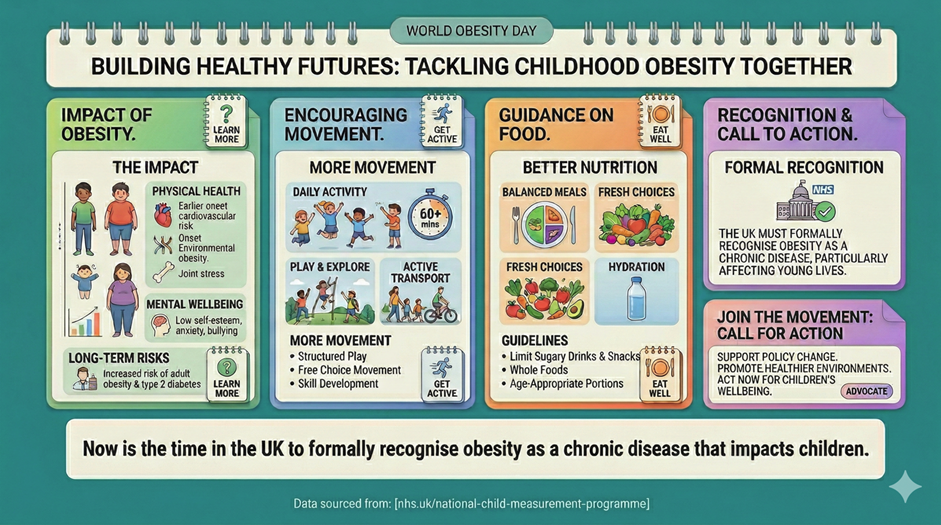
The infographic “Building Healthy Futures: Tackling Childhood Obesity Together” (image below) presents a stark visual narrative of a growing public health crisis in the UK. By integrating the data from the 2024-2025 National Child Measurement Programme (NCMP)and expert evidence, it becomes clear that obesity is not merely a lifestyle choice but a chronic, complex disease that requires immediate formal recognition and systemic intervention.
The scale of the crisis
The evidence from the NCMP highlights a disturbing trajectory. In England, 1 in 4 children in Year 6 (aged 10-11) are now living with obesity, a figure that has nearly doubled over the last thirty years. Even more concerning is the “deprivation gap”: children in the most deprived areas are more than twice as likely to live with obesity compared to those in the least deprived areas (29.3% vs 13.5%). This isn’t a failure of willpower; it is a symptom of an environment where unhealthy, ultra-processed foods are often the most affordable and accessible options.
The devastating health impact
As shown in the “Impact of Obesity” section of the infographic, the consequences are both immediate and long-term:
- Physical health: we are seeing an earlier onset of cardiovascular risks, joint stress, and Type 2 diabetes, conditions that were once reserved for adulthood. Severe obesity increases the risk of premature mortality, with some studies suggesting a three-fold increase in mortality rates before the age of 30.
- Mental wellbeing: the “hidden” impact is equally devastating. Children living with obesity frequently face weight-based bullying, leading to low self-esteem, anxiety, and depression.
- Long-term risks: a child living with obesity is approximately five times more likely to remain obese as an adult, entrenching a cycle of chronic illness.
Economic and societal costs
The financial burden on the NHS is unsustainable. Current estimates suggest that obesity and overweight-related conditions cost the UK economy roughly £126 billion annually, with direct NHS treatment costs exceeding £12 billion. For children specifically, weight-related health problems are estimated to cost the NHS hundreds of millions each year. Formal recognition of obesity as a disease would shift the focus from expensive, late-stage crisis management to proactive, preventative care.
A call for action: movement and nutrition
The infographic’s “Encouraging Movement” and “Guidance on Food” pillars provide a roadmap for change. We must move beyond simple “eat less, move more” mantras to create healthier environments:
- More movement: children need at least 60 minutes of daily activity. This requires safe active transport (cycling/walking to school), structured play, and “free choice” movement that fosters a sense of belonging and physical literacy.
- Better nutrition: guidance must focus on whole foods and hydration while limiting sugary snacks. The government’s recent restrictions on junk food advertising before 9 pm and “buy one get one free” deals are vital steps toward removing billions of “stealth calories” from children’s diets.
Now is the time
The message at the bottom of the infographic is the most critical: “Now is the time in the UK to formally recognise obesity as a chronic disease that impacts children.” Formal recognition would dismantle the stigma that prevents families from seeking help and would mandate the long-term funding needed for specialist clinics and school-based prevention. We cannot “look away” as another generation faces a lifetime of preventable illness. By supporting policy change and promoting healthier environments today, we can protect the wellbeing of the UK’s children for tomorrow.
Kristy Howells is Professor of Children’s Health and Movement in the School of Sciences, Psychology, Arts and Humanities, Computer Engineering, and Sports. For more information on her research, or if you’re interested in undertaking research in this area, do get in touch with Professor Kristy Howells via email: kristy.howells@canterbury.ac.uk.


