 Sustainability
 Bethany Climpson
 8692
8692
March is one of my favourite months, not only is winter finally starting to retreat into hiding for another year and the spring bulbs are starting to poke their heads, but it is also International Women’s Month. Now, the celebration of women and campaigning for their rights is a year-round effort that should not go unnoticed, but I like to think of the month as a time to showcase those who have come before and an opportunity to celebrate those paving the way for us today.
With International Women’s Month, feminism takes centre stage to the sound of both applause and scrutiny. For a long time, feminism has got a bad reputation due to a misunderstanding of what it is campaigning for. The feminist movement has been divided into waves across the past 200 years. The overarching goal of the feminist movement has been clear and concise, to achieve gender equality and rights for women. However, each wave has acted as an umbrella to group together distinctive events, and the ‘theme’ has not necessarily changed from one wave to the next. In fact, it mostly builds on what came before. I suppose you could argue feminism has had a rebrand over the last decade and we are now living in the ‘Fourth Wave’. Before we go much further, I encourage you to read this blog by Sustainability Engagement Officer, Bethany Climpson: Bikini Kill, Riot Grrrls and Third Wave Feminism, to help you understand what came before where we are today with the feminist movement.
Feminism and the Fourth Wave
To go into a bit more detail, as defined by Google (in its simplest form), feminism is “the advocacy of women’s rights on the basis of the equality of the sexes”. Each ‘wave’ of feminism has had this overarching theme, but the goals have shifted over the years along with the times and what is in the greatest demand for change. Some argue that we are still in the Third Wave as (for the most part) there are no specific dates to signify the start and end. However, generally, the Fourth Wave is believed to have started around the late 2000’s to early 2010’s with the main agenda of building on inclusion, and questioning the meaning of empowerment, equality and freedom.
This wave also prioritises recognising the struggles of women of colour and combatting the exclusion of trans women. There is a notable priority of highlighting intersectional identities and the diversity within the community. Something that has helped it stand out is the involvement of social media in feminist activism. Social media first started to take off in 2006 with platforms like Facebook and Twitter (now known as ‘X’). Feminism in the age of advanced technology has enabled easier ways of raising awareness whilst simultaneously helping others to get involved (digital activism). People can do as much or as little as they can to get involved with the movement as feminist campaigning can take place with the click of a button.
Notable Moments of the Fourth Wave
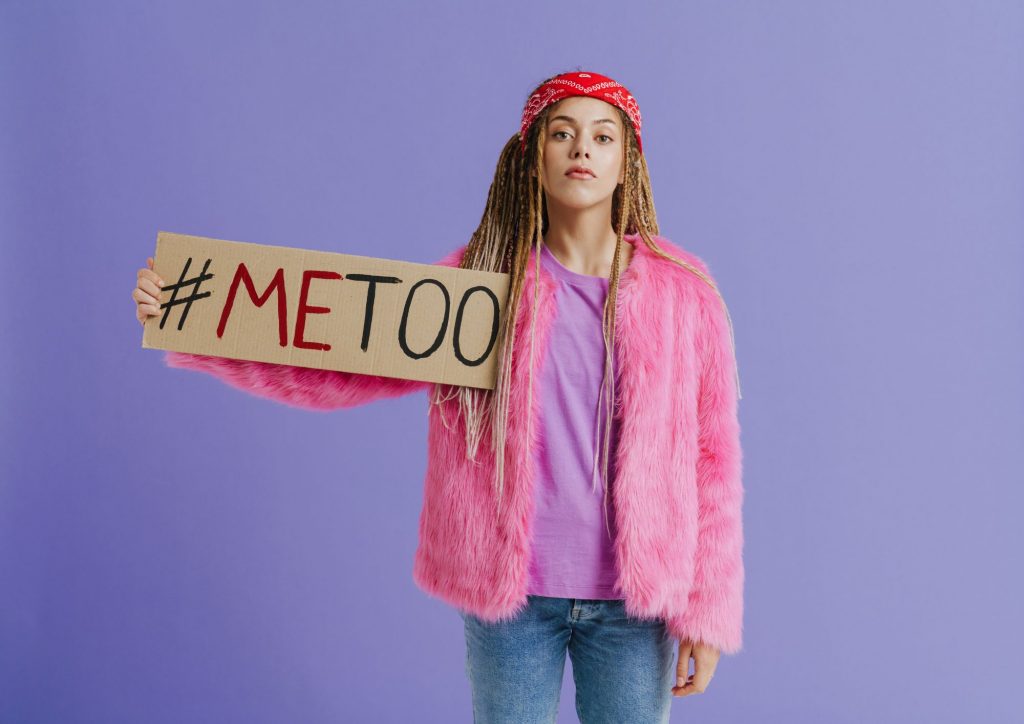
Image Description – A person holding a sign saying ‘#MeToo’
#MeToo
‘Me Too’ was first founded in 2006 as a movement against sexual violence. In 2017, after the explosive New York Times piece on Harvey Weinstein’s sexual misconduct was released ‘MeToo’ became a trending hashtag on social media and global movement. It was a message of solidarity, sharing the stories of survivors and supporting them to heal, with the overarching goal to put and end to systems that enable sexual violence and hold offenders to account. No matter who you are or where you come from, ‘Me Too’ is there to support those affected by sexual violence and help people find their voices again.
Alongside the rise of social media during the Fourth Wave and #MeToo, people were coming together online to share their stories and raise awareness. Whilst for some this was extremely personal, for others it was an opportunity to show their support and let survivors know they were not alone. This was instrumental in bringing Feminism into the new wave and helping to redefine the new era – redefine what it means to be a feminist. A strong example of this was the recent media coverage of Gisele Pelicot who came forward about the sexual abuse she faced from her husband and many other men. It sparked a similar #MeToo movement in France, with the motto “shame must change sides” poignant given the nations steep history in sexual abuse.
SlutWalk
SlutWalk became an international movement in the early 2010’s, campaigning to bring an end to rape culture and the associated victim and ‘slut’ shaming. This was a counter act after Canadian police implied the clothing choices of women led to victimisation when trying to mitigate sexual assault. This movement presented in marches in cities such as Toronto, Canada with 3000 people and London, England with 5000 people. These marches also took place in America, Australia, Iceland, South Africa, Singapore and many others. Women took to the streets with signs and dressed in ‘provocative’ clothing to change the narrative – clothing choices are not a form of consent, they are not an invitation.
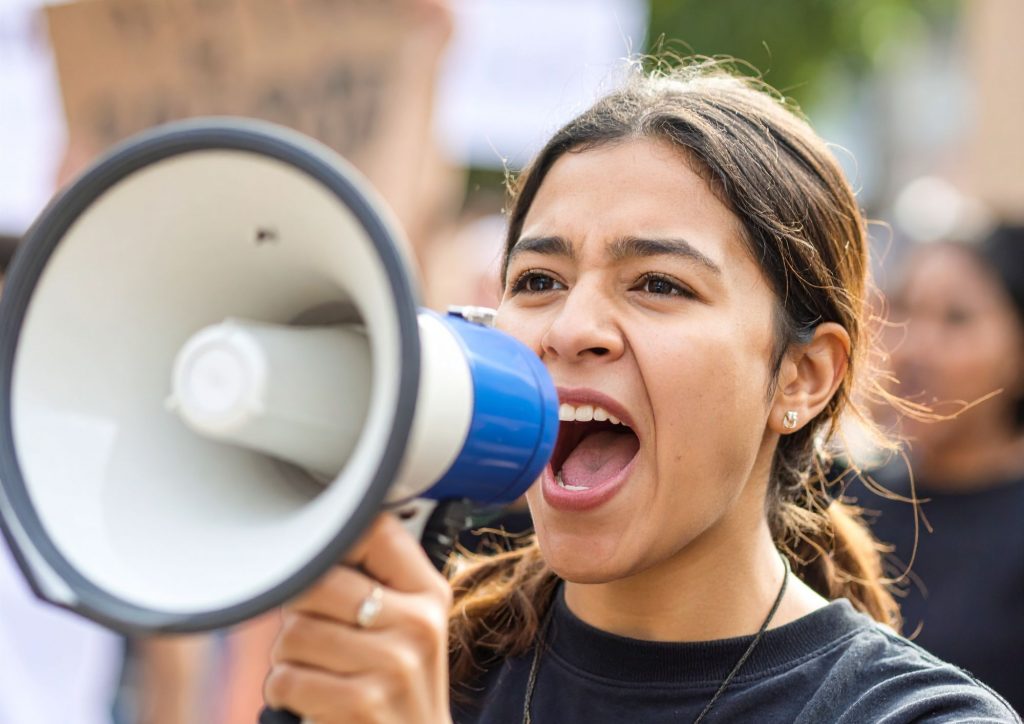
Image Description – A person with a megaphone protesting
Women’s March
Organised in the wake of a shock presidential election, 2017 saw the largest protest in US history with around 500,000 people in attendance. This march was not just limited to the US and took place across all seven continents including 30 people on Antarctica. It is estimated that 5 million took part worldwide! The march was in response to Republicans taking control of the White House and the agenda it ensued. It has been credited as a likely aid in Democrats taking back control in 2020 and an influx of women in politics.
Supporters of Women’s March were also influential in other campaigns such as March for Our Lives, protesting gun violence, and racial justice protests over the death of George Floyd. Recently, the movement has lost support and is also deemed likely to have influenced the retaking of control by Republicans. Women’s March has since been rebranded as People’s March to aid exposure of other campaigns such as those on reproductive rights and the LGBTQ+ community.
The Handmaid’s Tale
Many are noticing that the events of dystopian novels such as George Orwell’s ‘1984’ and Margaret Atwood’s ‘The Handmaid’s Tale’ are coming to life. People have been taking to the streets in Buenos Aries, Argentina in the poignant dress of Handmaidens. It has become a present-day symbol of oppression in the fight against the decriminalisation of abortion to reduce the risk of illegal abortion and subsequent death. This was also in particular response to the remarks of the newly elected republican president in 2017 saying women who have abortions deserve “some form of punishment”. Similar displays have also been seen more recently as issues persist.
Newer expressions of feminism have enabled an influx, as people can be more selective with the advocacy and how they go about it. I would argue that less rigid views around what it means to be a feminist is more beneficial in achieving the goals. The fundamentals should remain, equality and equity for all regardless of any individual characteristics with a deepened understanding of intersectional identities and the influence this has on experiences. Earlier on I mentioned how each wave of feminism usually builds on what came before, the third wave was about sexual liberation whilst the fourth wave campaigns against sexual abuse, harassment and violence. These events discussed above greatly reflect this. Unfortunately, due to rights once more being threatened, older campaigns are taking prevalence again, most recently the reproductive rights of women and ownership over one’s body. This article provides and overview of the issues we are facing today: Reproductive rights are under threat | Reproductive rights | The Guardian
Did you take part in any of these landmark moments? Or are you currently campaigning? What would you add to this list? Let us know!
Thanks for reading, Maddie 😊
Fancy some extra reading? Check out our sources:
- Fourth-Wave Feminism Explained – 2025 – MasterClass
- Types of Feminism: The Four Waves | Human Rights Careers
- me too. Movement
- Slutwalk London: ‘Yes means yes and no means no’ – BBC News
- 6 Signs You Might Be an Accidental Feminist | Crossway
- She helped launch the Women’s March. This year it’s an afterthought. – BBC News
- Is the Pelicot rape trial sparking #MeToo moment in France?
- The waves of feminism: a (very) brief history – The New Feminist
- How the handmaid became an international protest symbol – BBC News


