 The Poetic Nursing Heart
 Tom Delahunt
 1591
1591
On Red Threads, Wandering, and the Quiet Work of Freedom
There is also a small confession I should make. I am not entirely sure who will read this, or whether anyone will find comfort or meaning in the journey I am describing. Much of this writing emerges from a place of uncertainty rather than authority. But I am slowly learning that uncertainty should never prevent expression. Sometimes the act of speaking honestly into the world is enough. If these reflections resonate with even one wandering soul, then perhaps the thread has done its work.
#hobopoet
The Red Threads
Somewhere beneath the surface
where roots speak softly to one another,
a thread begins.
Not loud,
not certain,
just a quiet tug
in the direction of trees.
You follow it.
Across hospital corridors
and meadow paths,
through notebooks and half-written poems,
through doubt, through wonder.
The thread splits,
then splits again
one becoming many.
A wandering lamb.
A butterfly farmer.
A quiet view beneath the canopy.
For years they seemed separate stories.
But underground
they were always connected,
woven like mycelium in dark soil.
Today I realised something simple.
The threads were never lost.
The Joining of the Red Threads
Today feels like a crossing point.
For the first time, two strands of my writing life meet in the same place.
This piece will be published both on The Poetic Nursing Heart and on Substack.
It feels symbolic somehow.
For years I have been writing across different spaces: academic research, poetic reflections, ecological projects, wandering thoughts written in notebooks and margins.
Sometimes these strands felt separate.
Sometimes they felt like fragments of different lives.
But recently I have begun to recognise something else.
Beneath the surface, they were always connected.
Like the mycelial networks that run beneath a forest floor, quietly linking trees, roots and soil into a living conversation.
Merlin Sheldrake describes these fungal networks as systems of profound relational intelligence, sharing nutrients and signals across ecosystems in ways that challenge our understanding of individuality (Sheldrake, 2020).
Perhaps our ideas move in similar ways.
The wandering lamb.
The butterfly farmer.
Hunter Moon.
The quiet view beneath the trees.
The doctoral research into emotional sustenance in nursing.
Each began as a separate story.
But underground, they were part of the same network.
And recently I realised something unexpected.
There may be seven steps to becoming Bombadil.
Not the character exactly, but the state of being that Tom Bombadil represents in Tolkien’s mythology.
A person who has stepped outside the dominant systems of power and ownership.
Someone who belongs to the land rather than trying to control it.
Someone who wanders freely, attentive to the rhythms of the world.
Step One
The Awakening
Every journey begins with a moment of dissonance.
A quiet recognition that something about the system we inhabit no longer fits.
For me this began in nursing.
Not because nursing lacked meaning, but because the emotional labour required of nurses often exists without the structures necessary to sustain it.
The diagram that accompanies this piece represents part of my doctoral research: the idea that healthcare systems acknowledge emotional burden but rarely provide the deeper forms of emotional sustenance that sustain practitioners over time.
Wellbeing initiatives exist.
Supervision structures exist.
But something deeper remains missing.
Something relational.
Reflective.
Creative.
Something that nourishes rather than merely stabilises.
That realisation was the first thread.
Step Two
The Unlearning
The second step is harder.
It involves unlearning the false self.
Many traditions speak of this moment: philosophers, mystics, poets. It is the moment when the identity constructed through expectation, hierarchy, and institutional belonging begins to loosen.
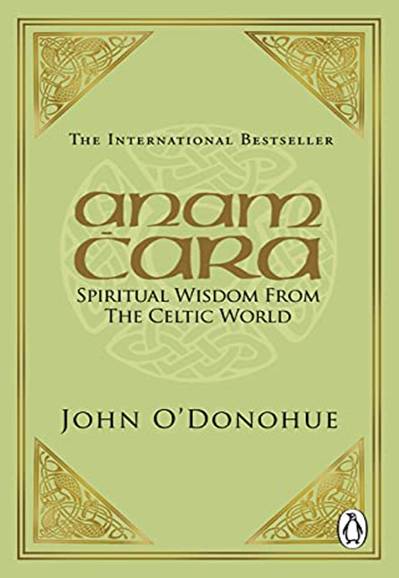
The Irish philosopher and poet John O’Donohue writes in Anam Cara that creativity and belonging arise from an inner landscape that exists beneath the surface of language and social roles (O’Donohue, 1997).
To encounter that landscape requires a kind of humility.
The recognition that the self we have been performing may not be the truest version of who we are.
This unlearning can feel unsettling.
It can feel like loss.
But beneath that uncertainty something quieter begins to grow.
A deeper orientation.
A more honest compass.
Step Three
Listening to the Underland
At some point the wandering leads underground.
Not literally, but metaphorically.
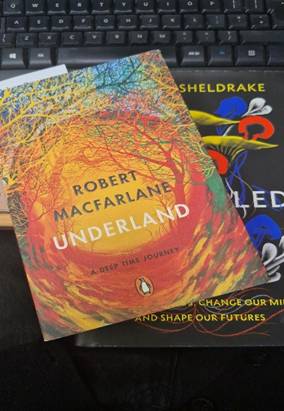
In Underland, Robert Macfarlane explores the hidden worlds beneath the earth, caves, root systems, buried histories and deep geological time (Macfarlane, 2019).
These subterranean spaces challenge the surface narratives we live by.
They remind us that much of reality exists beyond the visible and the immediate.
Merlin Sheldrake’s work on fungal networks extends this perspective. Mycelial systems form vast underground webs of communication and exchange, allowing forests to share nutrients and signals across complex ecological relationships (Sheldrake, 2020).
Life, it turns out, is far more collaborative than our cultural stories often suggest.
Ideas move like mycelium.
Quietly.
Relationally.
The work I had been doing, poetry, gardens, research, education projects, began to feel less like separate initiatives and more like nodes in a living network. (Delahunt 2024, 2025)
Step Four
The Wandering
Wandering is often misunderstood.
In modern culture it is sometimes seen as aimlessness.
But historically, wandering has been a form of philosophical practice.
The Cynic philosopher Diogenes wandered the streets of Athens rejecting the material values of his society.
Mystics across traditions have stepped outside conventional structures in order to encounter deeper truths.
In Tolkien’s mythology, Tom Bombadil is a wanderer who exists outside the structures of power that dominate Middle-earth.
He does not seek control.
He simply is.
There is something profoundly liberating about this orientation.
To walk without needing to possess.
To observe without needing to dominate.
To belong without needing to conquer.
Step Five
The Garden
At some point the wandering begins to root.
For me this rooting took the form of gardens.
The Butterfly Farmer project began as a small ecological idea, creating spaces where biodiversity could flourish within school environments.
But the gardens quickly became something more.
They became places of reflection.
Places of conversation.
Places where young people could experience the rhythms of nature directly.
Gardens teach patience.
They teach relational thinking.
They remind us that growth happens slowly, often invisibly, beneath the soil.
Much like the mycelial networks Sheldrake describes, gardens reveal that life thrives through interconnection rather than isolation (Sheldrake, 2020).
Step Six
Building the Quiet Economy
Eventually the question emerges.
If this way of living feels more aligned, how do we sustain it?
How do we create lives that allow time for wandering, reflection, creativity and care?
This question has practical dimensions.
It is about economics as much as philosophy.
It is about building what might be called a quiet economy, small networks of meaningful work that sustain both livelihood and purpose.
For me, this includes gardens, education partnerships, writing, research and community projects.
It may also include something more literal.
A van named Skye, slowly being restored, which may one day allow a different kind of mobility and freedom.
Not escape.
But movement.
Step Seven
Becoming Bombadil
Tom Bombadil is one of Tolkien’s most mysterious characters.
He exists within Middle-earth yet outside its systems of domination.
The Ring of Power, the object that corrupts nearly everyone who encounters it, has no influence over him.
Perhaps Bombadil represents a simple truth.
Freedom is not always achieved by defeating systems.
Sometimes it emerges by stepping outside their logic entirely.
By living differently.
By wandering.
By tending gardens.
By writing poems.
By building relationships that function like mycelial networks beneath the visible world.
If Underland reminds us that the deepest truths lie beneath the surface (Macfarlane, 2019), and Entangled Life reveals the relational networks that sustain ecosystems (Sheldrake, 2020), then Anam Cara offers the language of soul friendship that helps us recognise the deeper companionship guiding a meaningful life (O’Donohue, 1997).
Perhaps becoming Bombadil is not about transformation at all.
Perhaps it is simply about remembering.
Remembering how to belong.
A Final Thought
I am not entirely sure why I felt called to write this piece today.
Perhaps it is simply a moment of recognition.
The wandering lamb.
The butterfly farmer.
The researcher.
The gardener.
The quiet observer beneath the trees.
For a long time they felt like different identities.
But now they feel like red threads woven into the same tapestry.
If this piece offers anything, I hope it offers a small reminder:
There are other ways to live.
Sometimes the path forward is not about climbing higher within the existing system.
Sometimes it is about stepping sideways.
Into the forest.
Onto the path.
And beginning, quietly, to wander.
References
Delahunt, T. J. (2025) The shared palette: how philosophy, art, and phenomenology can help nursing education heal trauma, PRACTICE, DOI: 10.1080/25783858.2025.2603937
Delahunt, T. J. (2024). Nurturing nursing professionals: unleashing the rhizomatic power of expression, creativity, and art as resistance. PRACTICE, 6(2–3), 72–76. https://doi.org/10.1080/25783858.2024.2380280
Macfarlane, R. (2019) Underland: A Deep Time Journey. London: Hamish Hamilton.
O’Donohue, J. (1997) Anam Cara: A Book of Celtic Wisdom. London: Bantam Press.
Sheldrake, M. (2020) Entangled Life: How Fungi Make Our Worlds, Change Our Minds and Shape Our Futures. London: The Bodley Head.
Links
The poetic nursing heart blog https://blogs.canterbury.ac.uk/partnersinlearning/
The one form to rule them all


