 Sustainability
 Bethany Climpson
 598
598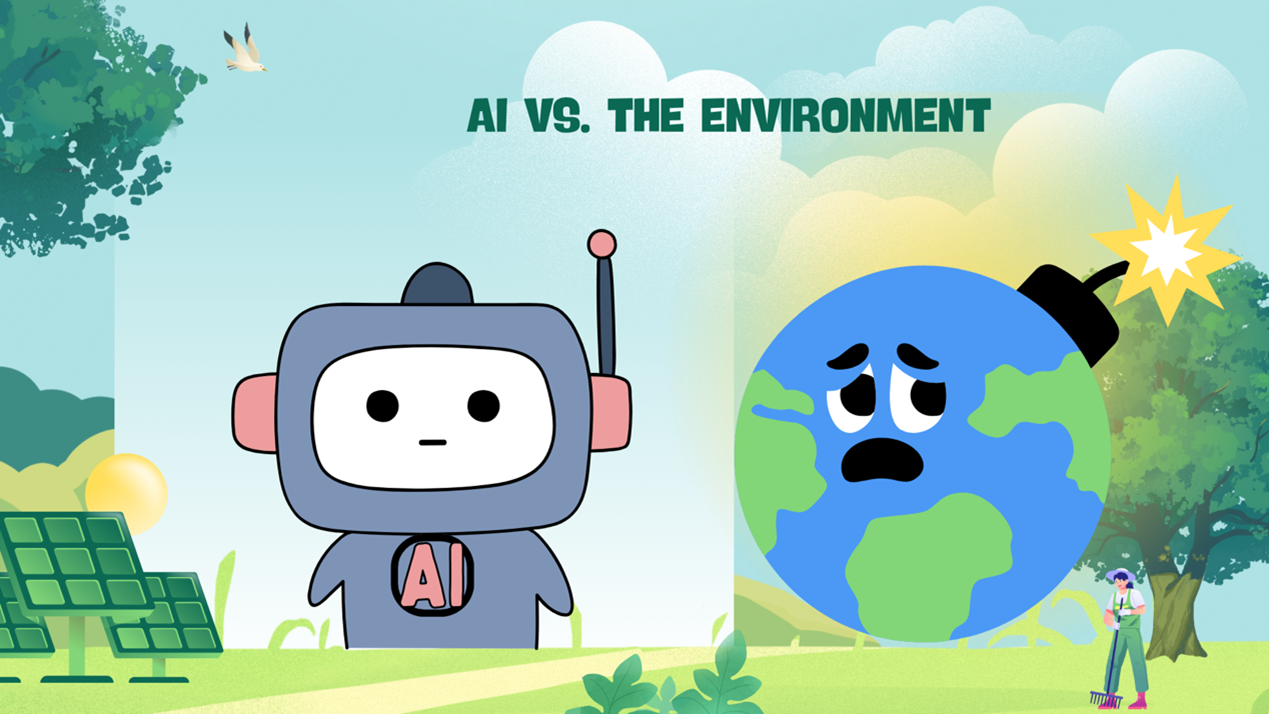
Do you, like I used to, rely on AI every single day—without thinking twice? From drafting emails to planning lessons, AI feels like a magic helper. But here’s something I just found out (and it blew my mind): every time you ask AI (such as ChatGPT, Gemini, or Copilot) a question, it can “drink” the equivalent of a half-litre bottle of water to keep the servers of its data centres cool (Patterson et al., 2022; Garcia, 2024).
Suddenly, that “free” answer doesn’t feel so free anymore.
⚡ The Hidden Costs of AI
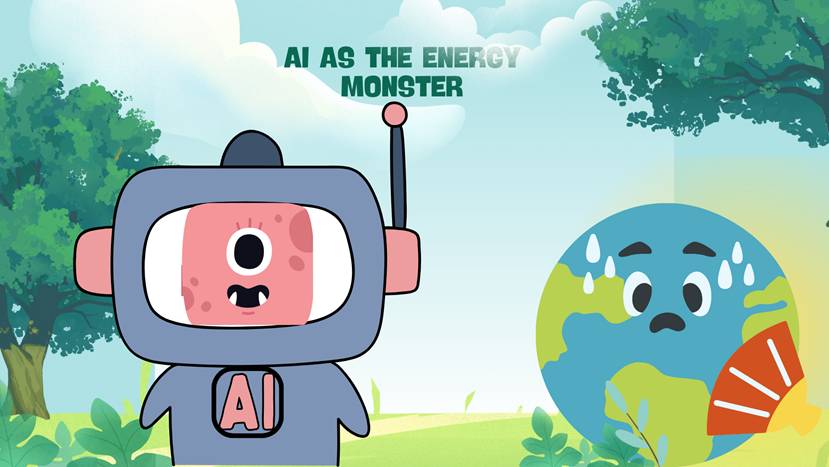
1. The Energy Monster
Training large AI models is like running a city’s worth of electricity.
- A University of Massachusetts study found that training one big language model emits 626,000 pounds of CO₂—about the same as 300 round-trip flights from New York to San Francisco (Strubell, Ganesh and McCallum, 2019).
- OpenAI reported that since 2012, computing power for AI has been doubling every 3.4 months (Amodei and Hernandez, 2018).
- The International Energy Agency (IEA) warns that by 2040, the ICT sector (AI, data centres, networks) could be responsible for 14% of global emissions (IEA, 2023).
Do you know how “thirsty” AI is? 💧 Recently, AI’s carbon footprint has received more attention, but what’s often overlooked is AI’s water footprint (Li, Yang, Islam and Ren, 2025). Microsoft revealed that its water use spiked 34% in a single year—thanks to cooling AI data centres (Garcia, 2024). That’s enough water to fill 2,500 Olympic-sized swimming pools. Looking ahead, global AI demand could require 4.2–6.6 billion cubic metres of water by 2027—as much as the annual water use of four to six Denmarks, or half of the UK (Li, Yang, Islam and Ren, 2025).
2. Mountains of E-Waste
AI hardware = endless upgrades. Chips, servers, and data centers eat up rare earth minerals and generate toxic electronic waste. The World Economic Forum predicts global e-waste could hit 120 million tonnes annually by 2050 (World Economic Forum, 2019). To put that in perspective, it’s roughly equivalent to every person on Earth throwing away more than a dozen laptops each year.
3. The Black Box Problem
Most companies don’t tell us how much energy their AI uses. Users see a neat chatbot, but behind the screen is a massive hidden footprint. From August 2026, the EU will force some AI developers to publish detailed energy reports (European Commission, 2023). Until then, it’s mostly guesswork.
🌱 The Bright Side: AI as a Green Hero
It’s not all doom and gloom—an analytical AI tool can also fight for the planet. Analytical AI helps monitor deforestation from space, track plastic in oceans, and forecast extreme weather. It can even design new eco-friendly materials and support precision farming, reducing fertilizer and pesticide use.
💡 So… Should We Use AI?
For companies, they should disclose energy use, invest in clean energy, and use their market power to accelerate the green grid. For example, Google’s DeepMind cut its data centre cooling bills by 40% using an analytical AI tool (Google, 2016). Another possibility is that water efficiency varies by location, time of day, and climate. Smarter scheduling can help. For instance, if a data centre is more water-efficient at night, shifting training workloads to cooler hours could save vast amounts of water (Li, Yang, Islam and Ren, 2025). For carbon reduction, data centres often follow the sun to maximize solar energy. But to save water, we may need to do the opposite—schedule AI workloads during cooler periods with lower cooling demand (Li, Yang, Islam and Ren, 2025).
For policymakers, they should demand transparency and set sustainability standards. The EU’s move to force reporting on energy use is a strong start (The Economist, 2025). They could also introduce incentives for companies that invest in renewable-powered data centres, set limits on water consumption in drought-prone regions, and create international benchmarks for AI sustainability. In other words, regulation should not only track AI’s footprint but also actively guide it towards greener practices.
For users (that’s us!), we’re not powerless. In fact, we can choose how we use AI — or even whether to use it at all. Now that we understand its water cost, we can make more conscious decisions and push AI toward greener futures in many ways.
- Think first 🤔 – Do I really need AI? Sometimes, the simplest way to save energy and water is to skip AI entirely. Not every search, draft, or task needs a model behind it. Choosing “no AI” can also benefit you: it strengthens critical thinking and problem-solving, improves memory and recall, builds writing fluency and voice, boosts creativity through productive struggle, protects privacy and data, reduces distraction for deeper focus, and helps you retain core skills (research, analysis, citation) that employers and universities value.
- Ask about sustainability 🌱 – Before choosing an AI app, check whether it reports its environmental footprint. If not, ask the company—public pressure works.
- Support green AI 💻 – Prefer platforms trained on renewable-powered data centres. Every choice is a market signal.
- Use smartly ⚡ – Batch your questions instead of keeping AI “awake” with dozens of prompts, or use smaller on-device models for simple tasks.
- Join citizen science 🔬 – Contribute to AI-for-good projects, like classifying wildlife images, tracking ocean plastic, or monitoring local air quality.
- Offset your AI footprint 🌍 – Just like offsetting flights, support reforestation or water conservation projects to balance out your AI use.
- Advocate in education 📚 – Students and teachers can integrate AI sustainability into class discussions, raising awareness and sparking innovation.
Because AI can either become a climate suspect 👀 or a climate hero 🦸— and the choice starts with us.
✨ Final Thought
AI is like fire: it can warm our home or burn it down. The choice is ours. So maybe the real question isn’t “Should we use AI?” but: “Can we use AI to build a greener future?” 🌍💚
By Huiwen Wang, SGO Projects Officer
References & Further Reading
Amodei, D., Hernandez, D. (2018). AI and Compute. OpenAI. DOI: https://openai.com/research/ai-and-compute.
European Commission (2023). Artificial Intelligence Act. DOI: https://artificialintelligenceact.eu.
Garcia, M., 2024. AI Uses How Much Water? Navigating Regulation Of AI Data Centers’ Water Footprint Post-Watershed Loper Bright Decision. Navigating Regulation Of AI Data Centers’ Water Footprint Post-Watershed Loper Bright Decision. DOI: https://papers.ssrn.com/sol3/papers.cfm?abstract_id=5064473.
Google DeepMind (2016). DeepMind AI reduces Google data centre cooling bill by 40%. DOI: https://www.deepmind.com/blog/deepmind-ai-reduces-google-data-centre-cooling-bill-by-40.
IEA (2023). Electricity 2023: Analysis and forecast to 2025. DOI: https://www.iea.org/reports/electricity-2023.
Li, P., Yang, J., Islam, M.A. and Ren, S. (2025). Making AI less “thirsty”: Uncovering and addressing the secret water footprint of AI models. Communications of the ACM. DOI: https://doi.org/10.48550/arXiv.2304.03271.
Patterson, D., Gonzalez, J., Hölzle, U., Le, Q., Liang, C., Munguia, L.M., Rothchild, D., So, D.R., Texier, M. and Dean, J. (2022). The carbon footprint of machine learning training will plateau, then shrink. Computer, 55(7), pp.18-28. DOI:10.1109/MC.2022.3148714.
Strubell, E., Ganesh, A. and McCallum, A. (2019). Energy and policy considerations for deep learning in NLP. In: Proceedings of the 57th Annual Meeting of the Association for Computational Linguistics (ACL). Florence, Italy, July 2019. DOI: https://doi.org/10.48550/arXiv.1906.02243 [Accessed 3 October 2025].
The Economist. (2025). How AI could help the climate: The technology could help decarbonise the industries that have proved the hardest to clean up. The Economist, 10 April. DOI: https://www.economist.com/leaders/2025/04/10/how-ai-could-help-the-climate.
World Economic Forum. (2019). A new circular vision for electronics: Time for a global reboot. In support of the United Nations E-waste Coalition. Geneva: World Economic Forum. DOI: https://www3.weforum.org/docs/WEF_A_New_Circular_Vision_for_Electronics.pdf.


