 Politics
 Kamalakhanim Aghazada
 50
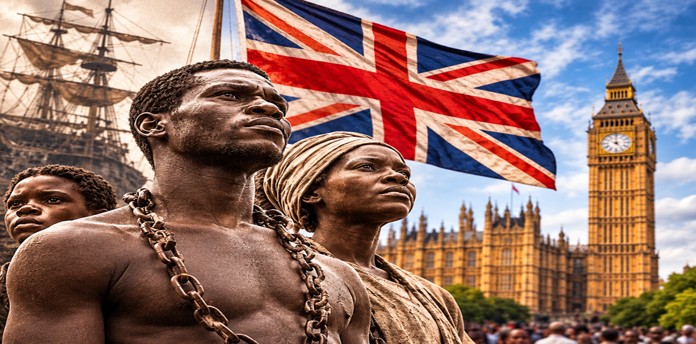
Dr Dele Babalola examines where British politicians stand on the issues of slavery and reparations, and why inherited benefits, rather than individual culpability, provides the moral case for saying sorry.
The 2026 Commonwealth Summit has reignited debates over slavery and reparations. It has pushed Britain’s unfinished business with slavery back into the global spotlight, with the issue of apology and reparations dominating discussions. The transatlantic slave trade was not just a footnote in British history; it was a major activity. For centuries, British ships transported human cargo, British ports benefited from this heinous trade, and British laws protected merchants who profited from the enslavement of millions of people. The wealth created by this trade was not accidental to Britain’s rise; it was intended and integrated into the country’s economy and infrastructure. Yet, nearly two centuries after the trade was abolished, the question of whether Britain should officially apologise and pay reparations remains unsolved.
The ongoing debate has at least produced some sort of clarity in certain quarters. We now have some understanding of our leaders’ perspectives on the subject. Prime Minister Andy Burnham has made a significant step by declaring his willingness to make a formal apology, expressing sadness and regret for the anguish and suffering of many millions, and admitting that the slave trade was a “brutal and barbaric violation”. While Burnham has declared that financial reparations are “not on the table,” his willingness to engage in a genuine conversation on the issue is a refreshing departure from the avoidance that has typified British policy for generations. Liberal Democrat leader, Sir Ed Davey has taken a similar stance, stating that “saying sorry is always quite a good thing.” Though Davey has also stated that reparations are “not the right approach,” his moral intuition that acknowledgement is important is in order. Truth be told, both leaders deserve credit for breathing life into the conversation.
In contrast, Conservative leader Kemi Badenoch has maintained that no apology or compensation should be offered. Badenoch has wondered if African and Caribbean nations seeking an apology from Britain would also seek one from African kings and merchants who sold and profited from the trade. She has stated that the current generation of British people should not be held responsible for atrocities committed “before any of us were born”.
Kemi’s argument is myopic, and it demonstrates a deep ignorance of the actual history of colonialism, especially in the territory now known as Nigeria, where I, like Badenoch, trace my origins. Her framing implies that the history of slavery and colonialism is a straightforward story of equal participation, as if African monarchs and British empire-builders were symmetrical participants in a shared tragedy. Of course, African intermediaries were involved in the sale of their fellow Africans, but the demand, funding, ships, weapons, legal framework, and the global market were all European, with a strong British involvement. The British did not go to Africa as nation-builders; they went with warships, treaties enforced at gunpoint, and a mindset of racial hierarchy that justified the enslavement and colonisation of others.
Badenoch obviously did not learn, or chose to ignore, how the British forced their way into Nigeria. The Royal Niger Company, a private British company, secured “treaties” with local monarchs by coercion and trickery. “Agreements” were secured at gunpoint. Resistance was always met with military brutality. The most renowned example is Admiral Sir Harry Rawson’s Benin Expedition in 1897. The British force of about 1,200 soldiers burnt the Benin Kingdom’s capital (in modern-day Nigeria), looted its art, and exiled its ruler.
This history is not obscure; it has been documented – credit to the National Archives in London. The fact that a British political leader of Nigerian descent could claim that Britain’s role in Africa was one of genuine trade, or that the descendants of enslaved and colonised peoples bear equal responsibility for the systems that enslaved and colonised them, is an indictment of how Britain teaches its own imperial history. Or is this a case of convenient ignorance? Either way, this narrative only suits the interests of those who want to escape the uncomfortable realisation that Britain once participated in the heinous slave trade and owes a debt.
The moral case for apology and reparations is somewhat misrepresented. Critics hear in the word “reparations” a claim that British people alive today are personally guilty of crimes committed centuries ago. That is not the argument. No one is suggesting that a young family in Bristol or Liverpool bears personal culpability for the actions of a slave trader in Bristol. Individual guilt is not, and never has been, the basis of this case. The question is not whether today’s Britons committed the crime, the question is whether they continue to benefit from it. Britain profited in no small measure from slavery and colonialism. That profit was invested in infrastructure and the general wealth of the nation. The entire British economy was restructured around the trade in human beings and the exploitation of colonised labour. So, to say that the “British people today cannot be held liable for historical wrongs” is to misunderstand what reparation is.
I think Kemi needs to be told that reparation is not a personal accusation or a penalty; rather, it is the recognition of an obligation due not by individuals in their private capacity, but by the state righting the wrong. Britain’s present wealth is inextricably linked to its past horrors. Unfortunately, Kemi repeatedly talks about how Britain stopped slave trade, but she doesn’t talk about how slave traders were handsomely compensated for the loss of their “properties.” When slavery was abolished in 1833 by the Slavery Abolition Act of 1833, the British government paid £20 million in compensation to around 46,000 slave owners; nothing was paid to the enslaved, who were victims of the brutal trade, or their descendants. I ask Kemi to research how the debt was serviced by British taxpayers until 2015.
Reparations, whether through debt forgiveness, development financing, or direct compensation, are moral responsibilities. The Caribbean and African nations that have continuously raised this issue are the descendants of those whose labour created the wealth that Britain currently enjoys.
Andy Burnham’s willingness to apologise and engage in a “structured dialogue” is a start. Ed Davey’s moral clarity on the significance of apologising is appreciated. But Kemi Badenoch’s lack of knowledge of the history she cites, highlights how far Britain still has to go. A woman who grew up in Nigeria, a former British colony, and now leads a major party like the Conservative Party should know better. She should know that the British did not seek permission to enter (invade?) Nigeria and other parts of Africa. They did not go to trade as equals; they went to trade in humans, as well as exploit the resources of the continent.
An apology is the bare minimum. Britain should say SORRY.

Dr Dele Babalola is a Senior Lecturer in Politics and International Relations at Canterbury Christ Church University. His research focuses on federalism and political economy, particularly ethnicity, democracy and terrorism in Nigeria. He teaches on our undergraduate and postgraduate degrees and welcomes applications from PhD students interested in similar research themes.
His most recent publication is Babalola, D. and Seiyefa, E. (2025), Organised crime, violent conflicts and the movement towards a dual policing system in Nigeria, The Round Table, 114:4, 417-435, https://doi.org/10.1080/00358533.2025.2522843


