 Politics
 Kamalakhanim Aghazada
 16
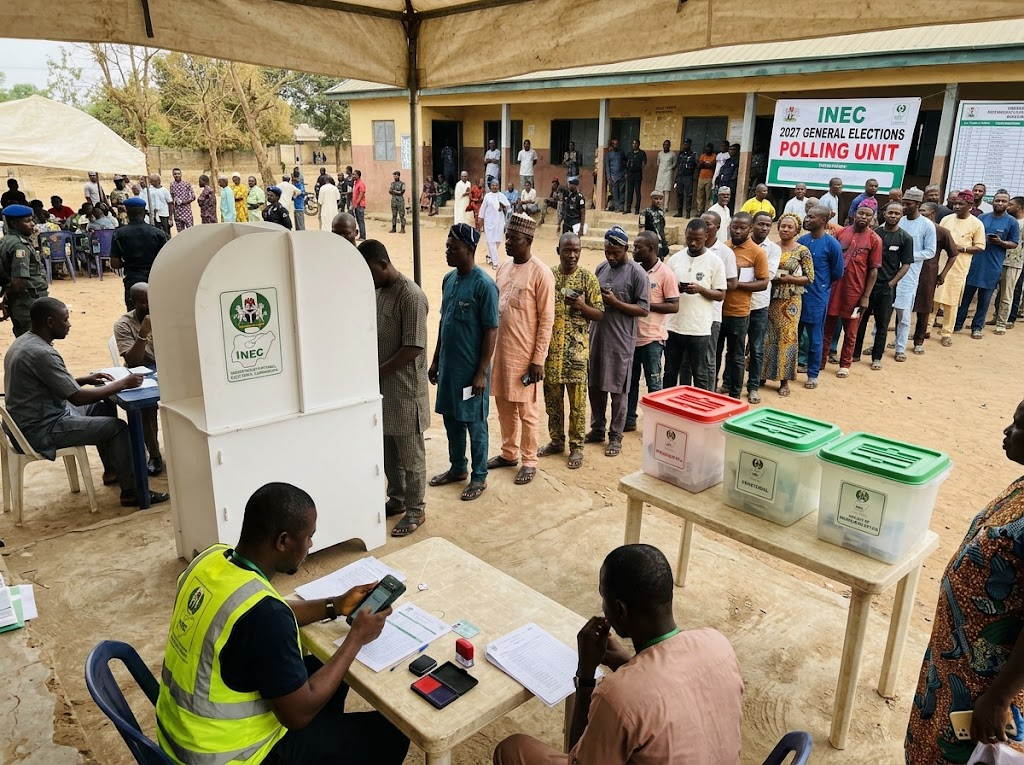
In this blog, our PhD researcher Ileowo Kikiowo discusses democratic backsliding in Nigeria, the challenges facing the country ahead of the 2027 general elections, and whether the upcoming elections can reverse this trajectory.
As Nigerians head to the polls in January 2027, the electorate has another opportunity to consolidate democratic gains by electing responsible leaders to political office. For the most populous black nation on earth, the stakes are high, as the entire black race looks up to Nigeria for its emancipation. However, certain issues remain germane and equally important as the nation continues to battle undemocratic norms and practices. Contrary to popular opinion, democratic backsliding seldom appears through abrupt military interregnum or state collapse; it creeps in through the subtle erosion of values essential to a thriving democracy (Omoigberale, 2026). This intervention examines Nigeria’s subtle autocritisation and assesses its pivotal moment to reverse the prevailing political trend in the upcoming general elections.
According to the list released by the Independent National Electoral Commission (INEC), there are 19 presidential candidates, 4,408 National Assembly candidates, of whom 1,195 are seeking Senate seats, and 3,213 are contesting House of Representatives seats. Overall, there are 1,491 positions, comprising 1 Executive President, 109 senatorial seats (3 per state plus 1 for the Federal Capital Territory), and 360 seats in the House of Representatives. For state elections, 28 state governorship elections are due across Nigeria’s 36 states, along with their deputies. Likewise, 993 seats are available in State Houses of Assembly across the federation’s 36 states. For now, the elections are billed to hold on 16 January 2027 for the Presidential and National Assembly elections and 6 February 2027 for the governorship and state houses of assembly elections.
Over the past decades, Nigeria has witnessed democratic backsliding. This is not surprising, given that only 5 per cent of the entire sub-Saharan African population lives under a thriving liberal democracy (The Seychelles and South Africa). Forty-nine per cent of the subsaharan population lives under an electoral autocracy, twenty-four per cent under an electoral democracy, and others under a closed autocracy (Nord et al., 2025). Nigeria, classified as an electoral democracy, lives in the ‘grey zone’, where key indicators of a thriving democracy are absent and, where present, are for showmanship, as political elites with unchecked executive powers use state apparatchiks to suppress dissent, wage lawfare against real or perceived opponents and restrict political participation, often through subterfuge. Though electoral democracy is the starting point for any polyarchy, democratisation demands further guarantees, such as the ability of opponents of government to openly and legally organise to oppose government in a free and fair election (Dahl, 1971).
Nigeria’s democratic experience since independence from Britain in 1960 has been marked by frequent military interregnums, and its current uninterrupted democratic dispensation is now in its 27th year. Citizens’ experiences during these years have been constant agitation for economic and democratic freedom. In the current republic, highly influential political elites often called the “cabals” (a metaphor which refers to an opaque, informal, secretive, highly influential group of people who control presidential decisions, exert immense behind-the-scenes control over government policies, state resources, and governance (Onyia and Aroh, 2019)) use the instrument of political office to usurp enormous executive power by coercing the legislature, judiciary and other regulatory bodies to extend constitutional powers, restrict participation and freedom of expression. 2027 presents a fresh chance for Nigeria to position itself as a bastion of democracy in a region surrounded by autocratic administrations. Niger, Chad, Cameroon and, more recently, Benin Republic are ruled by military dictators or electoral autocrats who perpetuate themselves in office through military coup d’état or constitutional amendments on political participation, term limits and duration. In fact, Nigeria ranks 57th of the 59 electoral democracies in the world and is classified in the ‘grey zone’ between an electoral democracy and an electoral autocracy (Nord et al., 2025).
The 2027 general election presents Nigeria with a fresh opportunity to demonstrate its credentials as a genuine democracy, with electoral activities that are free, fair, and open to participation without intimidation or fear of arrest. Beyond election day in January, the actions of political operatives must assure citizens and international observers of her readiness to transform Nigeria from a nation that symbolically heads to the polls every four years to endorse a leader as a fait accompli to one that makes every vote count. A free and fair election is sacrosanct for a liberal democracy to thrive. Already, opponents and ruling-party officials are pointing fingers at each other over violent attacks on opposition candidates and offices. As the elections approach, the news is awash with reports of daylight attacks with machetes and other dangerous weapons on an opposition presidential candidate and an opposition gubernatorial candidate was attacked while on campaign in different parts of the country. Likewise, state agents and non-state actors frequently arrest, harass, and intimidate ordinary citizens wearing opposition politicians’ campaign materials to predetermine election outcomes. Understandably, these allegations raise concerns, since the ruling party in government holds the monopoly on the legitimate use of force.
With the government’s power of coercion comes the tendency to autocratise. Scholars define autocratisation as the systemic, often gradual political shift away from democracy and toward authoritarian rule. Elected leaders seldom dismantle democracy at the start; instead, they systematically compromise checks and balances while maintaining a facade of democratic institutions. As Nancy Bermeo (2016) argues, modern autocratisation often relies on executive aggrandisement through strategic electoral manipulation, weakening institutional checks and balances, and the incremental expansion of power. When democracies backslide, the executive usually undermines the independence of the judiciary, legislature, civil service, and other state institutions. For example, many Nigerians today believe the lawfare being waged against certain opposition figures amounts to the weaponisation of the judiciary to serve such an agenda. Legislative oversight is minimal or absent, while many political elites with corruption cases hanging over their heads are eased of such burdens when they decamp to the ruling party. In addition, Nigeria has witnessed most opposition governors decamp from their parties to join the ruling party, leaving only five governors out of 36 in opposition parties. Of the remaining five opposition governors, four are coordinators of the re-election campaign of the incumbent president, while only one, who is a contestant for the position himself, is in the ‘real’ opposition. So, despite the seemingly open political space, organisation and participation in activities opposing the ruling party are covertly forbidden while maintaining the appearance of a free and fair system.
Restoring faith in the democratic system and reversing the backsliding is possible as the elections approach. The following can help remove Nigeria from the ‘grey zone’:
- Legislative procedures mandating a full review of all bills before a vote must be strictly upheld. Furthermore, bills should be distributed to members in advance to ensure they are adequately prepared for floor debate in the National Assembly.
- The National Assembly can use the powers at its disposal to halt democratic backsliding by ensuring its leaders emerge through a fair democratic process, without executive interference.
- State institutions such as the judiciary, regulatory agencies, and law enforcement agencies must resist executive overreach, especially when executive decisions restrict open participation and freedom of association.
- Civil servants and law enforcement officials can resist antidemocratic or unlawful executive pressure through administrative non-compliance, while maintaining technocratic neutrality and rule-of-law standards.
- Civil society and the media have a dual role: as agents of enlightenment and mass mobilisation. The media and civil society should act as reliable sources that counter disinformation by autocratic forces. Through public dialogue, factual reporting, civic education, and fact-checking, they can reverse democratic backsliding. Together, they can mobilise the civilian populace as a democratic force that keeps potential autocrats at bay.
- Lastly, the commission charged with organising a free and fair election in 2027, INEC, must ensure a fair playing field for all, update its register by weeding out duplicate entries, voiding AI registrations and preparing technological tools well in advance that will ensure its transparency, so the world can vouch for the process from end-to-end.
References
Dahl, R. (1971) Poliarchy: Opposition and Participation Yale University Press, pp. 257.
Bermeo, N. (2016) ‘On democratic backsliding’, Journal of Democracy, 27(1), pp. 5–19. Available at: https://doi.org/10.1353/jod.2016.0012.
Nord, M., Altman, D., Angiolillo, F., Fernandes, T., Good God, A. and Lindberg, S.I. (2025) Democracy Report 2025: 25 years of autocratization – democracy trumped? Gothenburg: V-Dem Institute, Department of Political Science, University of Gothenburg. Available at: https://www.v-dem.net.
Omoigberale, O. (2026) Democratic backsliding through bureaucratic capture: state power and institutional mimicry in Nigeria, Informa UK Limited.
Onyia, F.O. and Aroh, A.A. (2019) The Cabal Metaphor and Governance Deficit in Nigeria’s Democracy, International Journal of Politics and Good Governance.
Ileowo Kikiowo is a PhD Candidate in Politics and International Relations and an Academic Sessional in the School of Business, Law and Policing at Canterbury Christ Church University. He is currently researching the relationship between oil revenue and the pursuit of true federalism in Nigeria, with a focus on understanding how the nation’s resource-based economy influences its governance, political and federal structures.


