 Politics
 Laura Cashman
 264
264
Drawing on graduate Kojo Apeagyei’s experience in Africa’s AI sector, third year Joshua Bottomley examines how emerging technologies are reshaping development and opportunity across the continent.
AI’s relatively recent anointment as the world’s preeminent automation and data broker has the potential to reach previously underutilised areas across the developing world. The quest for data to train AI is expanding into Africa, challenging the stereotypical assumption that surrounds novel technologies, that innovation, progress and adoption can only occur in America, Europe and Asia. Africa’s utilisation of AI and recognition of potential for development on a national and continental level is in part fuelled by the contribution of Monday’s alumni guest, Kojo Apeagyei, who joined us for our weekly ‘Africa and the World’ module.
After graduating from CCCU in 2015 with BSc Politics and IR, Kojo gained experience in the charity sector, working specifically with NGOs to supplement his degree with transferable skills and build expertise on domestic issues. His work with different organisations combined with his specialisation in African studies, led to a career change into the technology industry and AI, eventually securing employment as an AI consultant in Ghana’s rising industry.
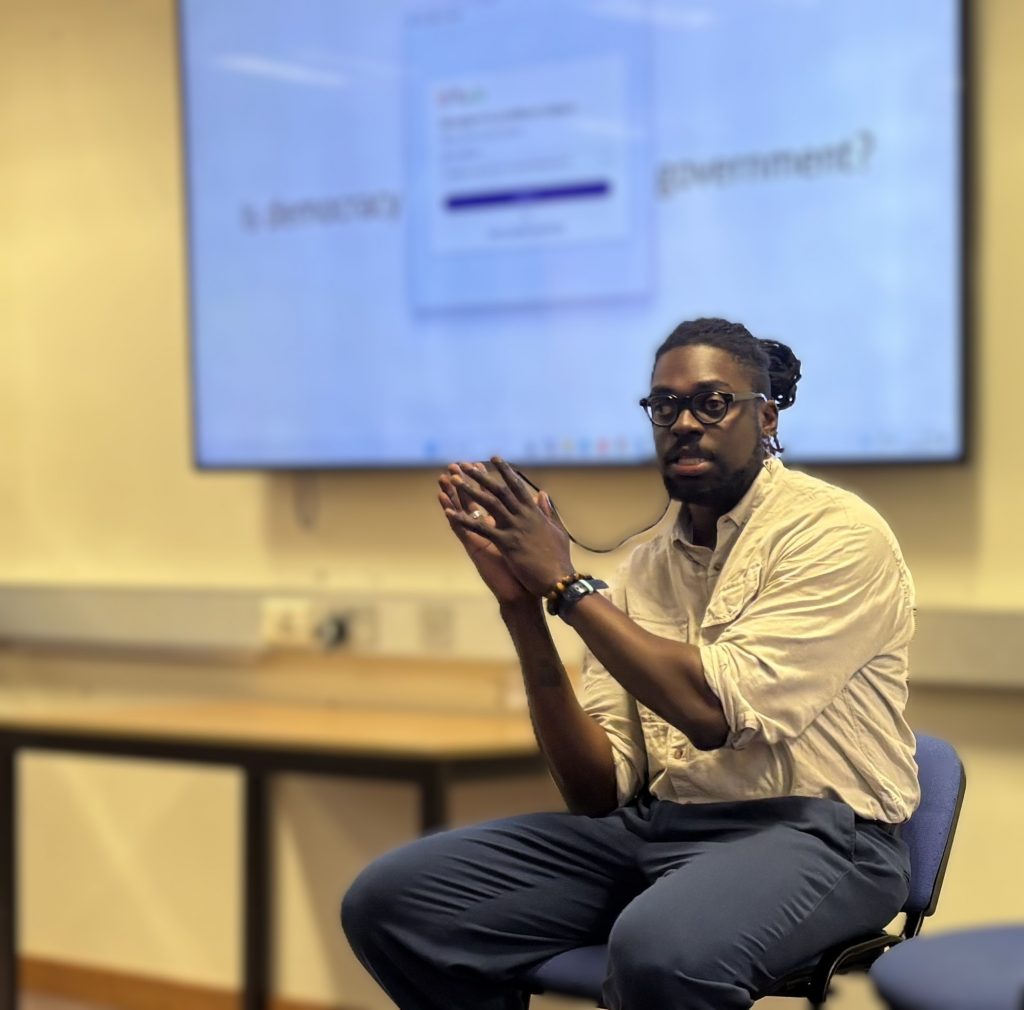
Restrained by ambitious aims and a shortage of coding and technology professionals, Ghana’s 10-year AI strategy (2023 – 2033) aims to train one million coders to an employment standard in this period, highlighting the value of Kojo’s work in the management of agricultural automation. For his part, Kojo spoke candidly about his role in the recruitment of aspiring AI professionals and the struggle and competition for African talent, in a continent all too aware of its vast potential and the opportunity AI presents.
Africa’s value as the biggest still untapped area of data for AI to learn from attracts international attention, as the non-digitised cultures of Africa prove enticing for monopolising new language models, for instance. The cultural and geographical proximity of African AI initiatives perfectly places Africa at the forefront of the opportunity to preserve endangered languages and cultures through AI. Despite the obvious embrace of AI in Africa, Kojo remained realistic about its limitations and existing challenges in Africa, such as corruption and the administrative and maintenance issues of AI hardware that may follow, a telling reminder that while new, progressive technologies may be transformational, they are only as effective as they can be trained and maintained.

Joshua Bottomley is a third year BSc International Relations student at CCCU.
Cover Photo Credit: Shutterstock


