 Politics
 Laura Cashman
 96
96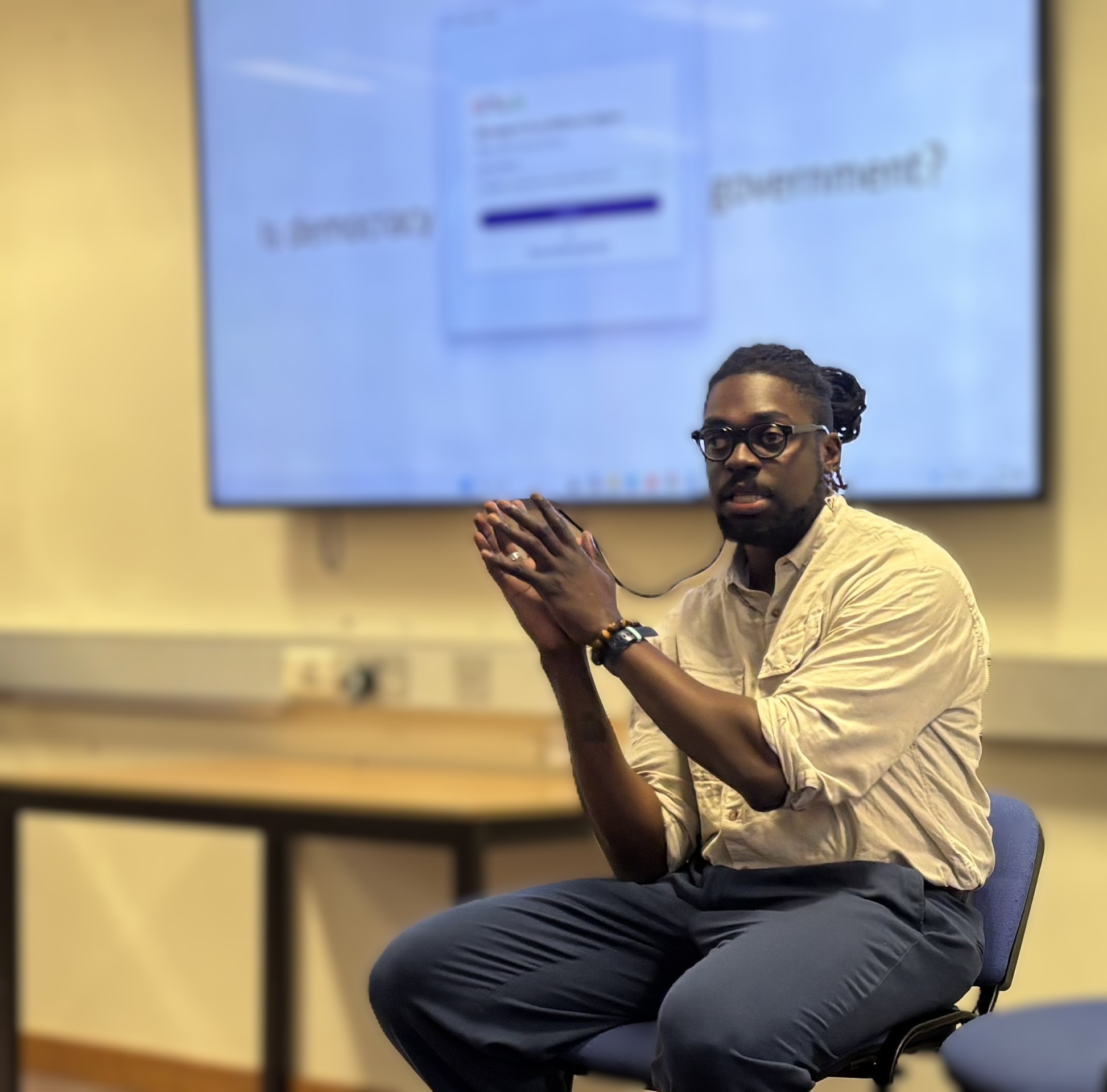
In Mariia Kaliuzhna’s second contribution to our Get Grad Ready series, she reflects on the insights of Pol IR graduate Kojo Apeagyei, drawing on his experience as an AI consultant and researcher.
As a part of Get Grad Ready week at CCCU, my Politics and IR class had the pleasure of welcoming Kojo Apeagyei, a 2015 graduate who has since built an impressive career as an AI consultant and researcher. Today, he works across the UK energy sector through Energy Systems Catapult and collaborates with African government agencies, focusing on ethical design and responsible deployment of AI.
During our conversation, Kojo shared the remarkable story of his journey to his current position and explained what it is like to work as a researcher, as well as the contemporary development challenges facing African countries today. In this blog post, I focus on his reflections about the difficulties of pursuing a research career and the skills that truly matter in the profession.
Firstly, it is important to realise that even if you have a solid knowledge of the industry you are interested in, it is highly unlikely to get a place in a professional company without work experience. In Kojo’s case, he gained it through volunteering with charities, gradually building practical experience. Later, while completing his master’s degree, he worked on rewriting academic articles in blog format for LSE. These steps became crucial bridges between academia and industry. He also noted that his transition into the energy sector was possible largely because the company he works for is one of the few that help to bridge the gap between academic training and professional practice.
As Kojo emphasised, academic research is quite different from professional research, and, as a fresh graduate, you can never be fully prepared for real-world tasks. And employers are aware of this, too. This reality can be uncomfortable. Many students hope that strong grades alone will translate directly into career readiness. However, the era when getting a degree guaranteed a stable and comfortable position in the job market is long gone. One of Kojo’s insights about the working environment is that it is highly competitive and demands adaptability, resilience, and the willingness to move quickly, learn continuously, and manage stress effectively.
At this point, a natural question arises: what is the role of university? If it cannot make us fully job-ready, what does it offer?
According to Kojo, for Politics and IR students in particular, university plays an indispensable role in developing the single most important skill for a research career: the ability to identify and define a problem. A huge part of this skill is linked to critical thinking, which is a distinctive point for politics studies. Thus, the value of a degree lies in training students to recognise patterns, to ask the right questions, and to narrow down broad issues into workable research problems.
Ultimately, for me, Kojo’s visit reframed my vision of the research profession. For Politics and IR graduates who choose to specialise in areas not traditionally seen as “political”, the greatest challenge is finding organisations that genuinely value interdisciplinary thinking. This means seeking out companies that are open to those who can translate political and theoretical knowledge into practical sector-specific solutions. Yet once you find your place, a research career offers the opportunity to engage deeply with issues you genuinely care about while enjoying a healthy work life balance and continuous learning.

Mariia Kaliuzhna is a third year BSc Politics and International Relations student at CCCU


