 Student life and guidance
 Cassie Duce
 270
270
LGBTQIA+ History Month aims to highlight the contributions of LGBTQIA+ people historically and today. The theme for 2026 is ‘Science and Innovation’, which is very befitting for us at KMMS. There are many past and present LGBTQIA+ figures who have made significant developments to science and medicine, and we have highlighted a few for this year. You can find out more information on Kent’s (University and Students’ Union) and CCCU’s pages.
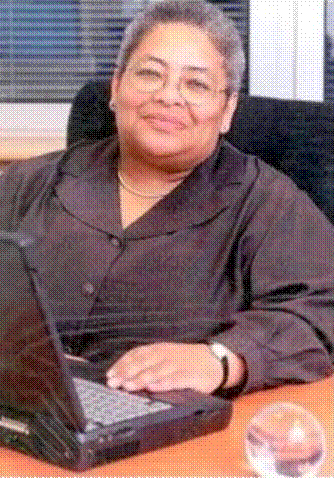
Barbara Burford (1944-2010)
Burford was a British medical researcher, civil servant and writer, who established NHS equality and diversity guidelines. She moved to London in 1955 from Jamaica and studied medicine at the University of London. In 1964 she worked for the NHS, specialising in electron microscopy at postgraduate teaching hospitals; later working for the Institute of Child Health and Great Ormond Street Hospital. In 1999 Burford was appointed Director of Equality for the Department of Health, where she helped create initiatives which linked equality to organisational performance, recruitment, progression and leadership development. This included encouraging NHS trusts to move beyond informal commitments towards more structured and accountable approaches to workforce fairness. Burford described herself as a descendant of three different backgrounds: African, Jewish and Scots, and a lesbian. She met her partner Joy Howard in 1987, and they became civil partners in 2007, living together until Burford’s death.
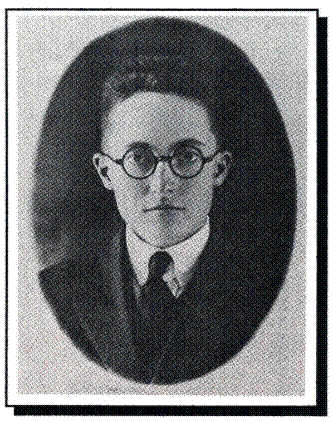
Alan Hart (1890-1962)
Circa 1917, Hart was one of the first trans men in the United States to undergo a hysterectomy. Throughout his life Hart faced adversity due to his gender expression, notably by his mother, at school and in newspaper exposés, but was accepted and supported by his grandparents. In 1917 Hart obtained a Doctor of Medicine from what is now Oregon Health & Science University but expressed sadness that this was issued in his female name. He devoted much of his career to tuberculosis research and pioneered the use of X-ray photography in tuberculosis detection, travelling across the United States to conduct mass X-ray screenings which ultimately led to a reduction in the death toll to 1/50th of what it had been previously. After his death, Hart’s wife acted on his wish to establish a fund for leukaemia research, from which Hart’s mother died.
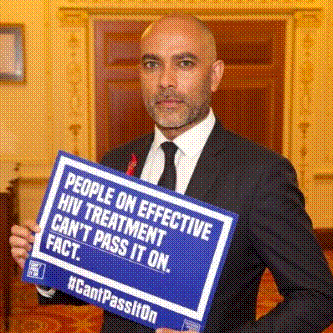
Michael Brady
Dr Brady was appointed as the first National Advisor for LGBT+ Health at NHS England in 2019, working to improve education and training for NHS staff relating to the needs of LGBT+ people, make the NHS a more inclusive and supportive place for LGBT+ people to work, improve data collection on sexual orientation and gender identity across the NHS and support the delivery of inclusive services for LGBT+ people. Dr Brady previously worked as a Medical Director for Terrence Higgins Trust, overseeing their HIV and sexual health services. He currently works as a HIV and sexual health consultant at King’s College Hospital and is a key voice in tackling HIV-related stigma and homophobic arguments against it, as well as promoting good sexual health.
Diverse teams and people are integral to the development of systems which benefit others through science and innovation, and raising awareness of these figures is the key theme of LGBTQIA+ History Month for 2026. You can find out more information at LGBT+ History Month 2026. You can also view our previous blog post, spotlighting even more figures for LGBT+ History Month 2024 where the theme was ‘Medicine – #UnderTheScope’.


