 Alumni
 Celia Pearce
 844
844Born out of her PhD thesis, Dr Diana Hirst (MPhil/PhD English Literature 2022) has published her first work exploring the novelist Elizabeth Bowen and her use of ‘light, atmosphere, fragmentation, and sensation’ in her writing. Described by the publisher as: ‘This is the first monograph to evaluate Elizabeth Bowen’s ‘verbal painting’, and the first to acknowledge the influence of the East Kent landscape in her novels.’ We spoke to Diana about her inspiration, the writing process and what fascinates her about the author.
What inspired you to write about Elizabeth Bowen’s work?

I knew about Elizabeth Bowen (1899-1973) – in the 1970s I had read a couple of her novels which had settings in East Kent, and they made an impact because in both cases there was a rather unusual young woman. When I retired in 2007 I thought I would study creative writing at the Institute of Continuing Education in Cambridge, but a literature module featured Bowen’s war stories. One in particular caught my attention: a monologue by a housekeeper who is welcoming (if that’s the right word) her mistress back to the home which has been bombed. Bowen’s prose mimics the state of the house – short unfinished sentences and lots of dashes seem to represent the shards of glass and splinters of wood, and ellipses are sprinkled around like dust. I was hooked. (Later I was to learn that she had written in an autobiographical note that much of her writing was verbal painting, which made sense.) So I switched to a Diploma on Bowen – this was on a single novel – and then did an Advanced Diploma on all ten novels. A PhD at Cambridge would not have been practical for various reasons, so I looked around and found that I could do one at Canterbury Christ Church. This had other advantages – I had grown up near Deal so knew the area well, and Bowen had lived in Hythe when she was a child and in her later years, and so I could look at her work from the perspective of Hythe and East Kent.
How did you find the writing process?
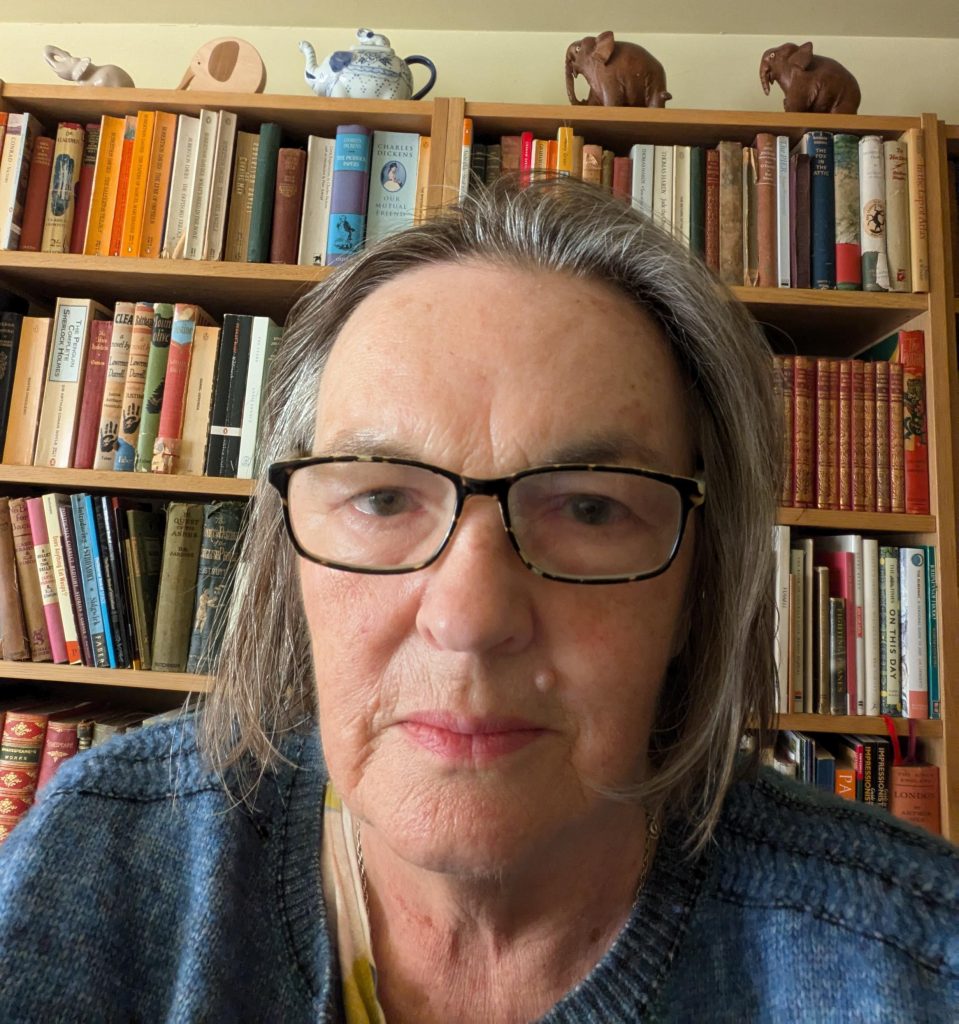
The writing process was fairly simple – after all, I had the experience of having written the dissertations as well as a thesis, and I could draw on these. I was very lucky that my external examiner took an interest in what I was doing and was generous with her advice. What was great fun was the research. I’d already got a fair amount under my belt. I started writing the book soon after we moved to East Sussex in late 2022. using online research, I discovered new things – and in fact I continue to discover new things. In the last two weeks I’ve discovered two new things – one just in time to include in the final proof of the book.
Do you have any plans to continue your writing, and if so, do you have a subject matter in mind?
I don’t see a life where I am not researching and writing about my research. However, I confess I am an antique – I came to this in retirement over fifteen years ago. So I will continue, but I don’t envisage anything major. I’d like to explore Bowen’s work in Kent: her time as Principal of the Kent Education Committee Summer School for Teachers between 1948 and 1950, and I’d like to discover the script for a radio programme she wrote for the BBC in 1946 – Return Journey: Hythe and the Romney Marshes. I’d also like to explore the influence of the French language and of poetic techniques on her syntax.
I also have an interest in the novelist Elizabeth von Arnim (1866-1941) who wrote a fictionalised account of her journey around Kent in The Caravaners (1909). Although it’s fiction, the places her characters visit are real. I’ve identified several of them, but there are still a few to find.
What advice would you give to students embarking on their own writing journey?
There will be times when you feel like jacking it in, but don’t. I have a visual brain, and I used to think of the PhD process as a journey along a long country path, shepherded by my supervisor. Suddenly you’d reach what feels like an impasse – a brick wall. But there are ways round brick walls – over, round the side, knocking a hole through, tunnelling under, or simply waiting for it to dematerialise. Or you can go back to the last turn off and strike out on that different course – a diversion which should bring you round to the other side of the brick wall. Whatever you do, don’t throw it in! Talk to your supervisor. And good luck!


